
Bathroom Hygiene Report
The Bathroom Habit 80% of the World Has That Americans Are Just Discovering
A quick read that might permanently change how you think about personal hygiene and what actually "clean" means.
By The Comfort Standard Community | 8 min read
Before you read this, I want to ask you something.
Have you ever thought, really thought, about what your bathroom routine is actually accomplishing?
Not in a judgmental way. Just genuinely: what does "clean" mean to you after you use the bathroom?
For most Americans, the honest answer is: toilet paper, done.
Evidence note: American toilet paper reliance is unusually high by global standards. Reporting on NRDC's forest-impact work has cited U.S. use at about 141 rolls per person per year, and NRDC's Issue with Tissue series has repeatedly documented how virgin-fiber tissue products contribute to pressure on forests like the Canadian boreal. Global Citizen / NRDC reporting · NRDC Issue with Tissue.
And until very recently, that answer felt completely sufficient. Normal. Unquestionable.
But here's what's quietly happening across the country right now:
Millions of Americans, professionals, parents, health-conscious people, perfectly ordinary people, are quietly installing a small device under their toilet seat. They're using it for a week. And then they're telling everyone they know about it with a level of enthusiasm that sounds almost embarrassing.
These aren't fringe wellness influencers. They're your neighbors. Your colleagues. People who stumbled across this information the same way you're reading it now.
And what they discovered wasn't a gadget. It wasn't a trend.
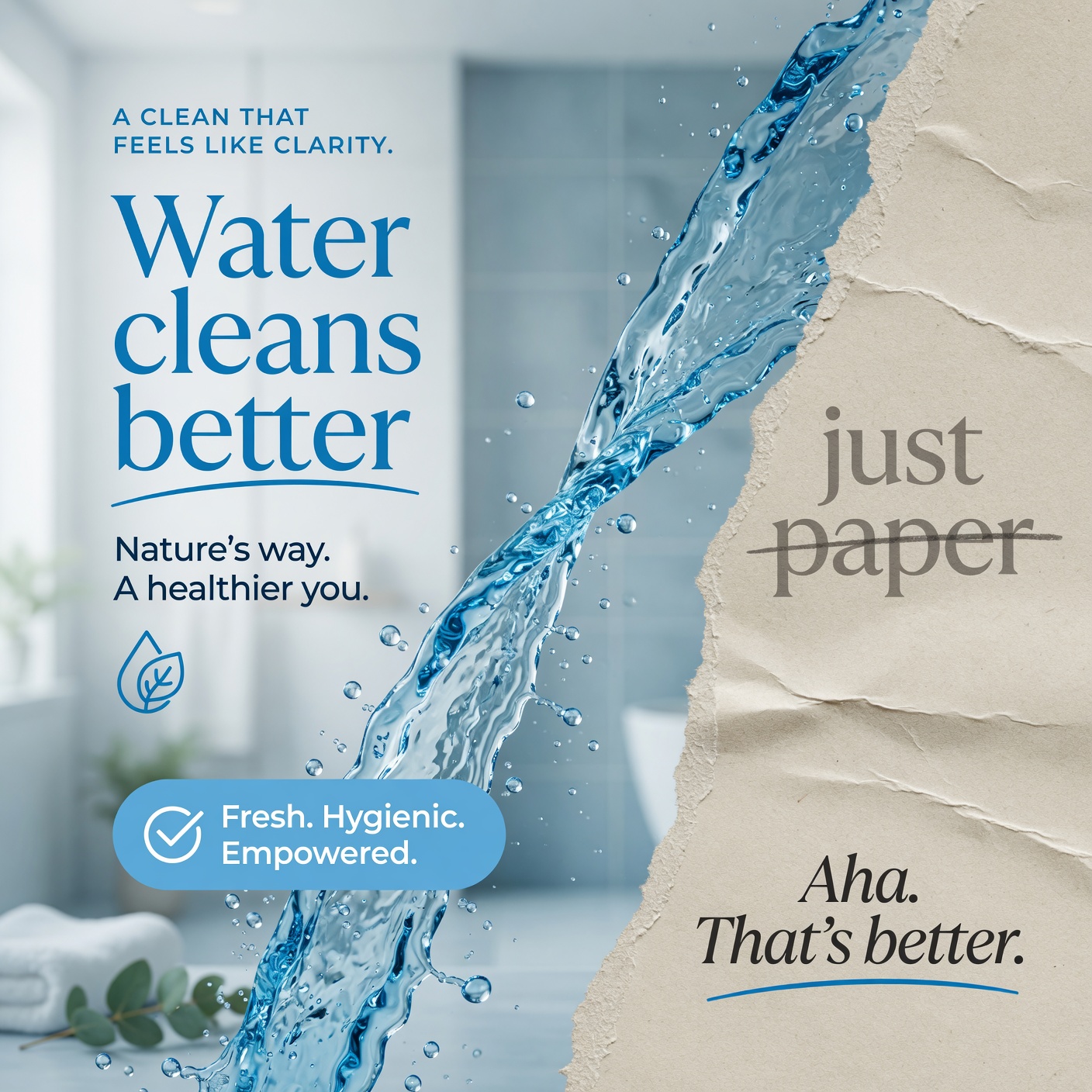
It was simply this: water cleans better than paper.
How Did America End Up Here?
It's actually a fascinating historical question.
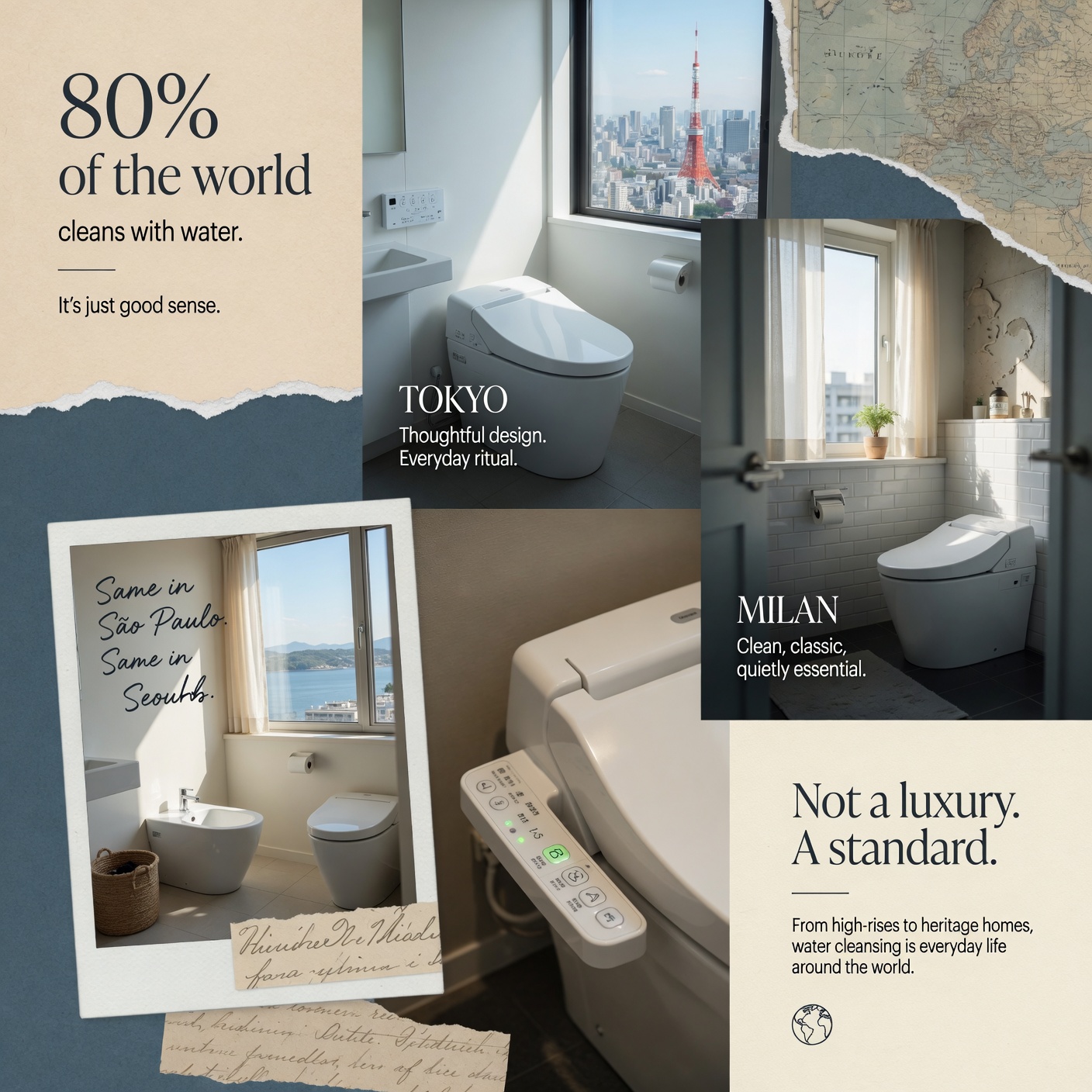
The bidet has existed since the 1600s. By the mid-20th century, it was standard in bathrooms across Japan, South Korea, Italy, Spain, France, the Middle East, and large parts of Asia and South America.
Evidence note: Smithsonian Magazine traces bidets to 17th- or early-18th-century France and notes that by World War II they had spread through swaths of Europe, the Middle East, Asia, and South America. In Japan specifically, a Cabinet Office consumer survey found 80.2% of two-or-more-person households owned an electronic toilet with bidet function in March 2018. Smithsonian history · Nippon.com / Cabinet Office survey.
But the United States took a different path, and it wasn't because of logic.
During World War II, American soldiers stationed in Europe encountered bidets almost exclusively in one place: brothels. That association, bidet equals immoral or un-American, came home with the soldiers and calcified into cultural norms over the following decades.
Context note: The "brothel association" is cultural history rather than medical evidence, but it is not invented ad copy. Smithsonian cites early American stigma around bidets being linked with French indecency, menstruation, prostitution, and brothel use. Smithsonian Magazine.
Then the toilet paper industry got involved.
By the time anyone questioned whether paper was actually the best solution, we were already spending $11 billion a year on it. The habit was invisible, which is the most powerful kind of habit there is. The kind you never examine because you've never had a reason to.
Meanwhile, the rest of the world kept using water.
Not because they had better technology. Not because they were more sophisticated.
We rinse our dishes. We wash our hands with running water. We shower instead of just toweling off sweat. Water and friction, not paper, is how human beings actually remove things from surfaces.
And yet, for this one specific moment in our day, we accepted paper as the standard.
The Thought Experiment That Makes This Click
Here's the analogy that converted more than a few skeptics:
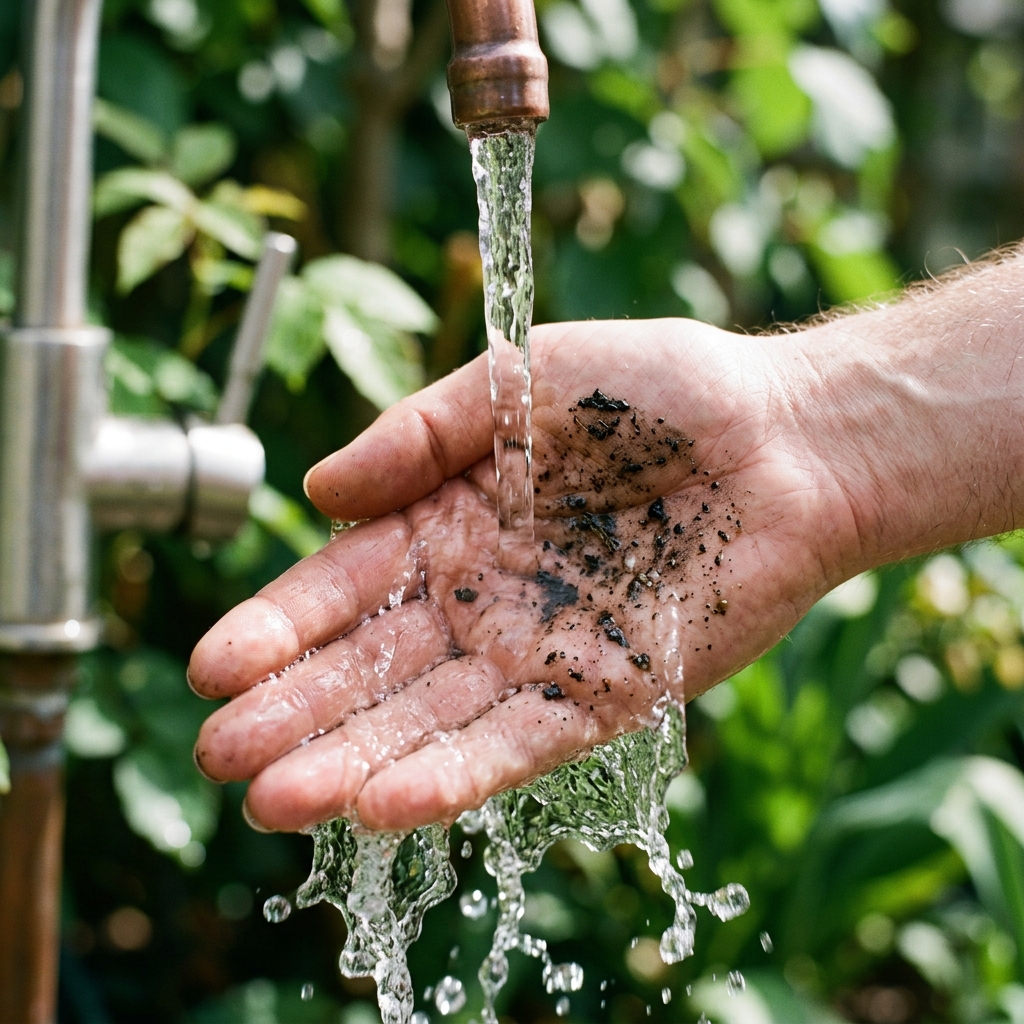
Imagine you get a solid smear of mud across your palm. Maybe you've been gardening, maybe it was a muddy walk.
Would you grab a paper towel and wipe it around a few times, then call your hand "clean"?
No. Of course not. You'd rinse with water. Immediately, without thinking.
Now: why is your bathroom routine held to a lower standard than your hand-washing routine?
The answer is: it isn't, logically. It just feels like it is, because that's what we were taught, and we never had reason to question it.
Once you see it this way, you can't unsee it.
The Science Agrees, But It's Not Complicated
You don't need a research paper to understand why water works better.
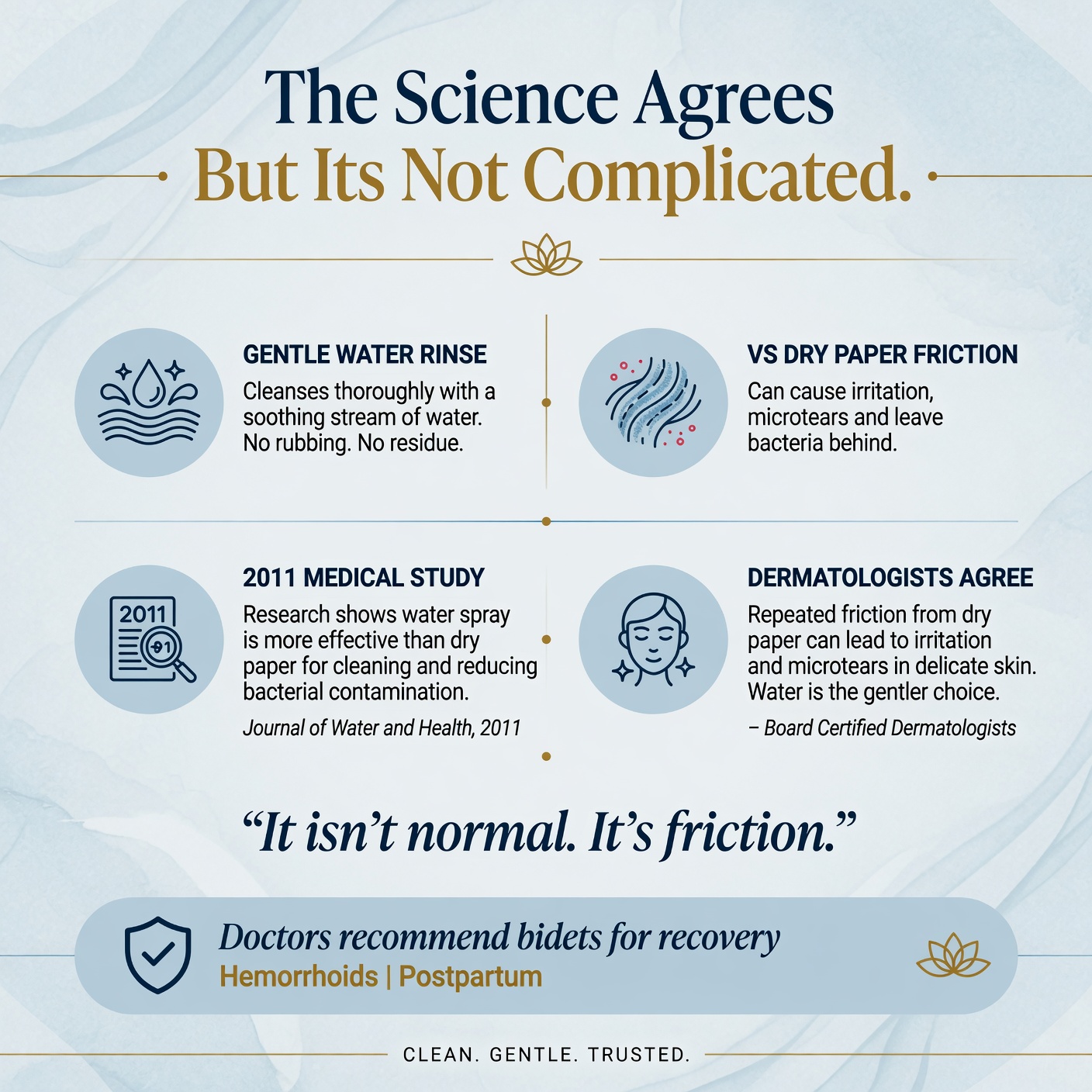
But if you want one: a 2011 study published in medical literature found that low-to-medium pressure water spray in the anal region relieves pressure and improves hygiene in a way that toilet paper simply cannot replicate. Dermatologists note that repeated friction from dry wiping can cause irritation, microtears, and that persistent low-grade discomfort many people assume is just normal.
Evidence note: A 2011 PubMed-indexed study found that low-to-medium pressure warm-water bidet spray reduced anal resting pressure in healthy volunteers under specific conditions. Separate clinical guidance on anal care recommends water-only cleaning and discourages excessive cleaning, while reviews of pruritus ani warn that excessive wiping or scrubbing can cause mechanical damage. 2011 bidet pressure study · Anal Health Care Basics · Anal pruritus review.
It isn't normal. It's friction.
Colorectal surgeons, OB-GYNs, and gastroenterologists have been quietly recommending bidet use to their patients for years, particularly for people recovering from surgery, managing hemorrhoids, dealing with postpartum sensitivity, or experiencing chronic irritation.
Evidence note: This is why water-based aftercare is so common in anorectal and postpartum contexts. NIDDK lists warm-water sitz baths as an at-home step to relieve hemorrhoid pain, and Cleveland Clinic notes sitz baths are used for hemorrhoids, anal fissures, and postpartum soreness and swelling. NIDDK hemorrhoid treatment · Cleveland Clinic sitz bath guide.
The medical community isn't shocked by the bidet. They're just waiting for Americans to catch up.
"But I Thought Bidets Were Expensive"
This is the biggest misconception holding most people back.
When most Americans picture a bidet, they picture a separate porcelain fixture next to the toilet, the kind you'd see in an upscale European hotel. Something that requires plumbing work, renovation budget, and probably a contractor.
That picture is about 30 years out of date.
What's changed the game entirely is the bidet attachment, a slim, non-electric device that fits directly under your existing toilet seat, connects to the water line already behind your toilet, and gives you a controlled, adjustable water spray with zero construction required.
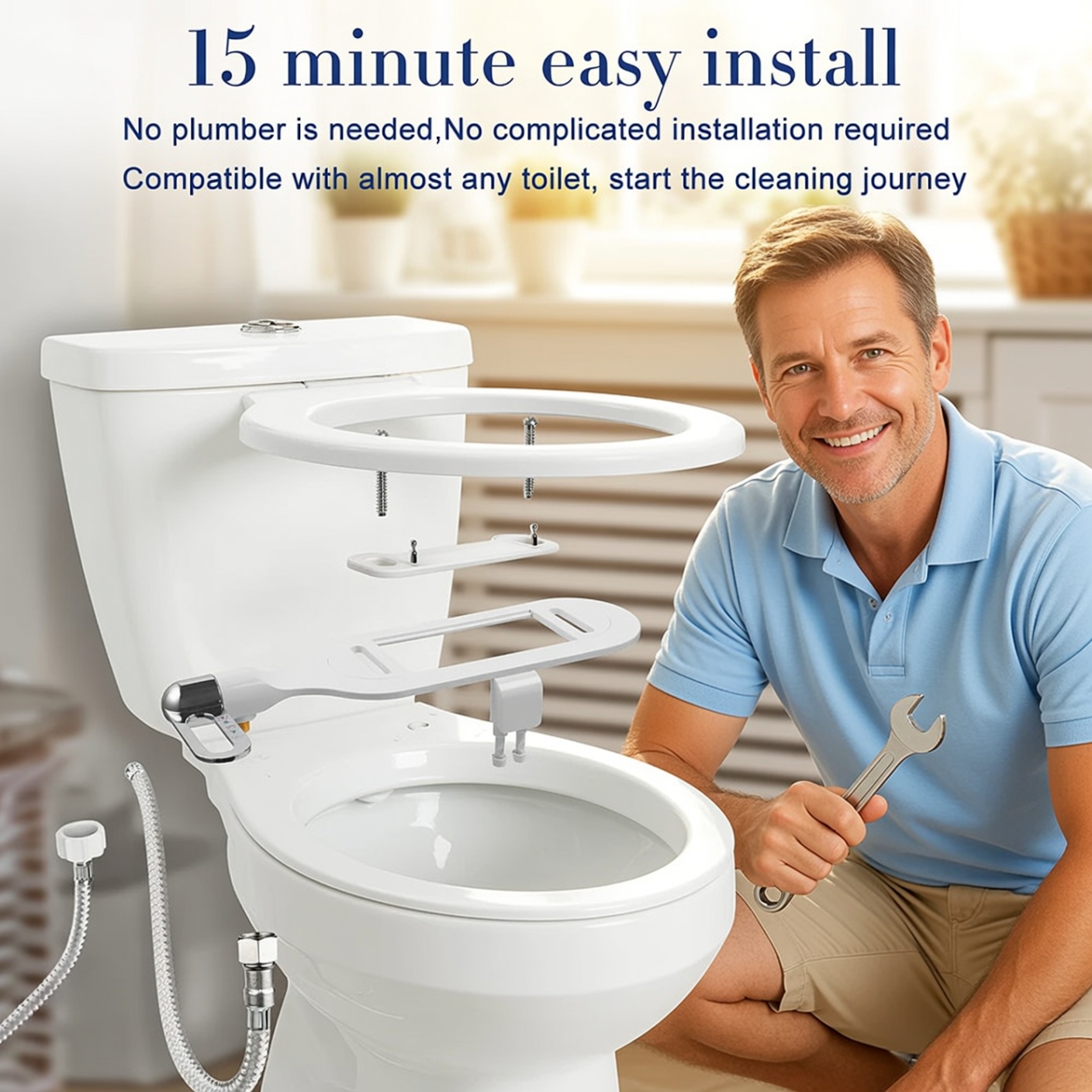
Here's what installation actually looks like:
- Turn off the water valve behind your toilet, about 30 seconds
- Remove your toilet seat
- Place the attachment on the toilet bowl
- Reinstall the seat on top
- Connect the included hose to the water inlet
- Turn the water back on
Total time: 15 minutes. No plumber. No special tools.
This is not a weekend project. This is a Tuesday afternoon task.
What People Actually Experience After Switching
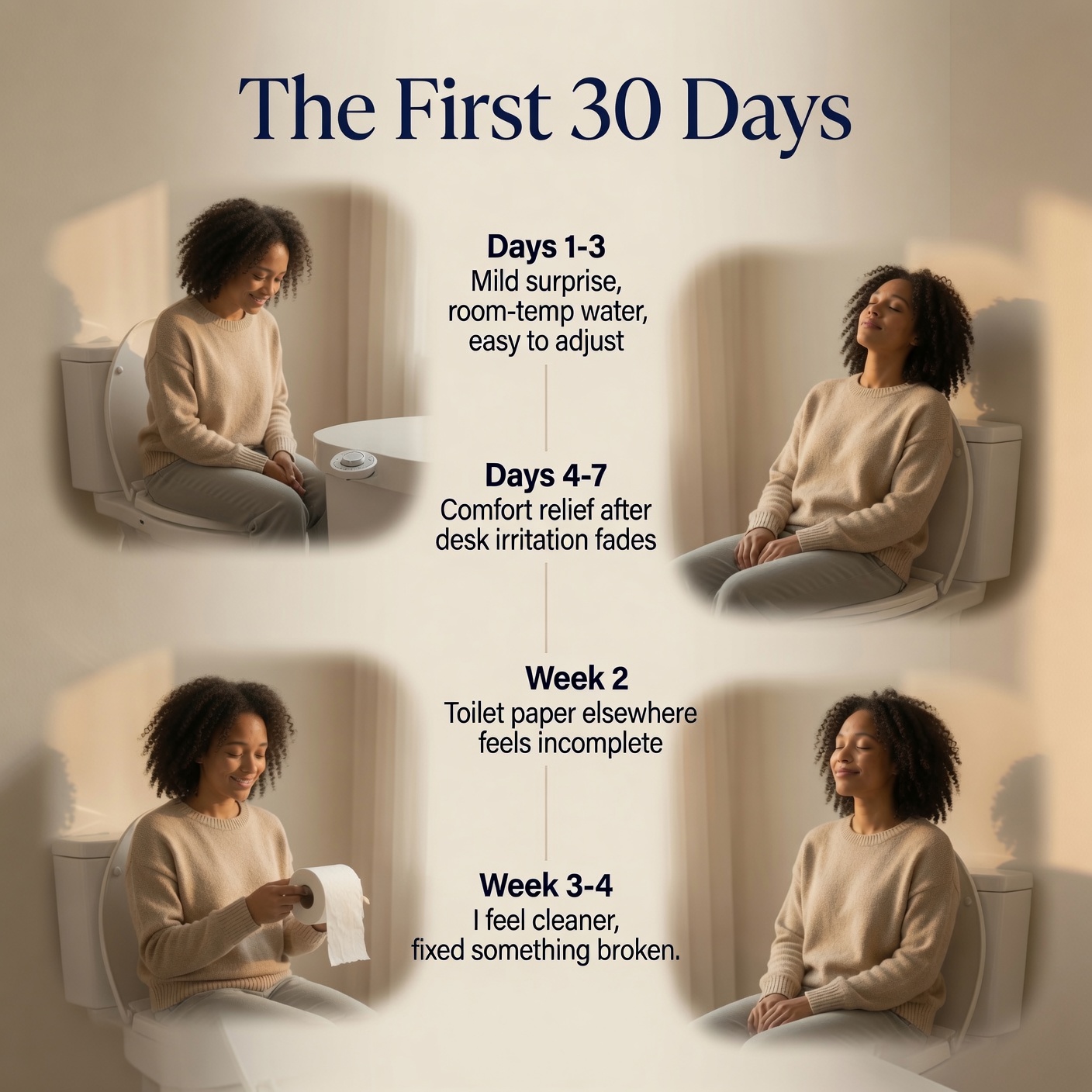
Let's talk about what happens in the first 30 days, because the pattern is remarkably consistent.
Days 1-3: The first reaction is usually mild surprise. The water is room temperature, not ice cold, not warm unless you have a warm-water model. Most people expect discomfort. Instead, they find it functional. Different. Easy to adjust.
Days 4-7: The comfort factor starts to register. That low-level irritation many people have accepted as baseline normal starts to fade. People who sit at desks all day notice first.
Week 2: Using just toilet paper somewhere else, at work, traveling, at a friend's house, starts to feel noticeably incomplete. Not dramatic. Just like you forgot a step.
Week 3-4: The conversion is complete. People in this category typically describe it the same way: "I don't miss it. I just feel cleaner. I feel like I've fixed something that was broken."
Common Objections, Answered Honestly
"Won't the water be cold and uncomfortable?"
The water that comes through a bidet attachment is the same temperature as the water in your bathroom sink, room temperature. Not cold like a glass of ice water. Most people adapt within a few uses, and the majority of converts report they stopped noticing the temperature entirely within a week.
"What about splashing everywhere?"
The spray is targeted and angled. It doesn't scatter. The pressure is adjustable, so you can start low and find what works for you. It's not like turning on a hose. It's designed for precision.
Use note: The science favors gentle, low-to-medium pressure. High pressure or overuse is not the goal; it can irritate sensitive tissue for some users. Start low, rinse briefly, and pat dry.
"I still need toilet paper to dry off, right?"
Yes. Most people use a small amount of toilet paper to pat dry after rinsing. Your toilet paper use drops by about 75-80%. Some people use a small dedicated towel. Neither option is wrong. You'll figure out what works for you within a week.
"Is it sanitary? Won't bacteria grow?"
The nozzle is typically made with self-cleaning mechanisms that rinse before and after use. The water source is the same potable water supply feeding your sink. You are not introducing anything new to your bathroom. You're adding running water to a place that already uses it.
Evidence note: Hygiene depends on design and maintenance. Studies have looked specifically at bidet nozzle cleanliness and spray-water quality: daily nozzle cleaning can reduce bacterial counts, continuous water discharge can wash away contamination, and hospital-setting research treats shared nozzles as surfaces that should be cleaned and monitored. Nozzle cleanliness study · Nozzle decontamination study · Hospital nozzle risk study.
"What if I'm renting or can't make changes to my bathroom?"
Bidet attachments require zero permanent modification. You unscrew a nut, add the device, reconnect the hose. When you move, you take it with you. The toilet and plumbing are returned to exactly their original state in under 5 minutes.
A Note on Who This Is For
Bidet attachments have been described as life-changing by people across the full spectrum:
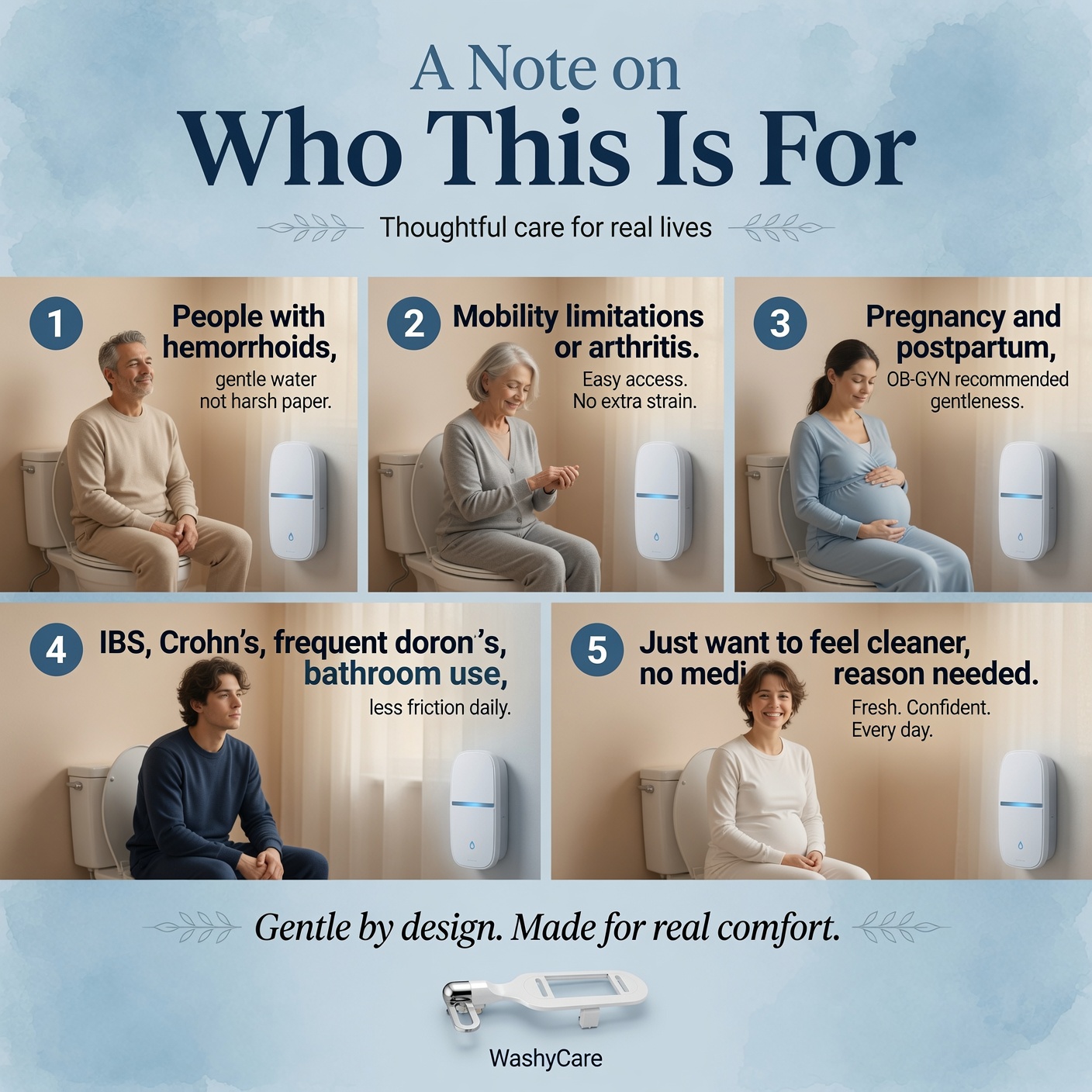
- People with hemorrhoids: Water spray is gentle where dry paper is harsh. Many describe it as the first genuinely comfortable bathroom experience they've had in years.
- People with mobility limitations or arthritis: Reduced need for manual wiping is a practical accessibility improvement many people don't consider until they need it.
- Women during pregnancy and postpartum: OB-GYNs frequently recommend bidet use during recovery. Gentleness matters a great deal in that period.
- People with IBS, Crohn's, or frequent bathroom use: Reducing friction for people who use the bathroom 6-10+ times per day is a quality-of-life upgrade that compounds quickly.
- Completely healthy people who just want to feel cleaner: You don't need a medical reason. "I want to actually be clean" is a complete sentence.
The Environmental Reality
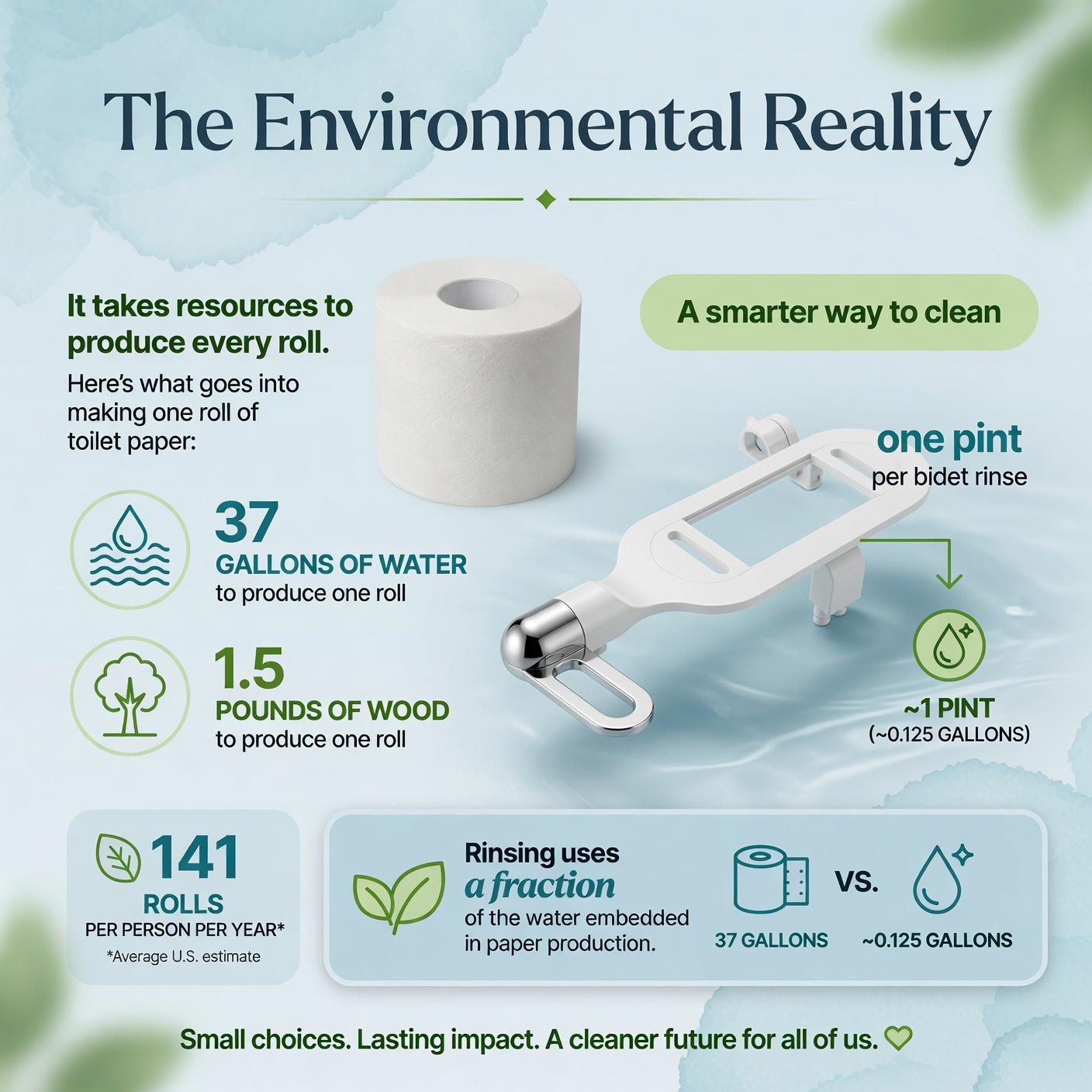
Production of a single roll of toilet paper requires approximately 37 gallons of water and 1.5 pounds of wood.
Americans flush about 141 rolls per person, per year, 34 billion rolls annually as a country.
A bidet rinse uses approximately one pint of water, a fraction of the water embedded in toilet paper production.
Evidence note: The exact water footprint per roll varies by roll size, pulp source, and whether the paper uses virgin or recycled fiber, so treat the 37-gallon figure as a commonly cited estimate rather than a universal constant. The stronger, better-documented environmental point is that virgin-fiber tissue keeps demand on forests, while reduced toilet paper use and recycled content lower that pressure. NRDC tissue scorecards · 141-roll U.S. usage reporting.
This isn't to guilt anyone. Most people had no idea toilet paper production was this resource-intensive. It's just an interesting piece of context: the "eco-friendly" option is actually using water to rinse, not the paper that required 37 gallons per roll to produce.
Why WashyCare by Hiwelly
There are a lot of bidet attachments on the market, and honestly, many of them do roughly the same job.
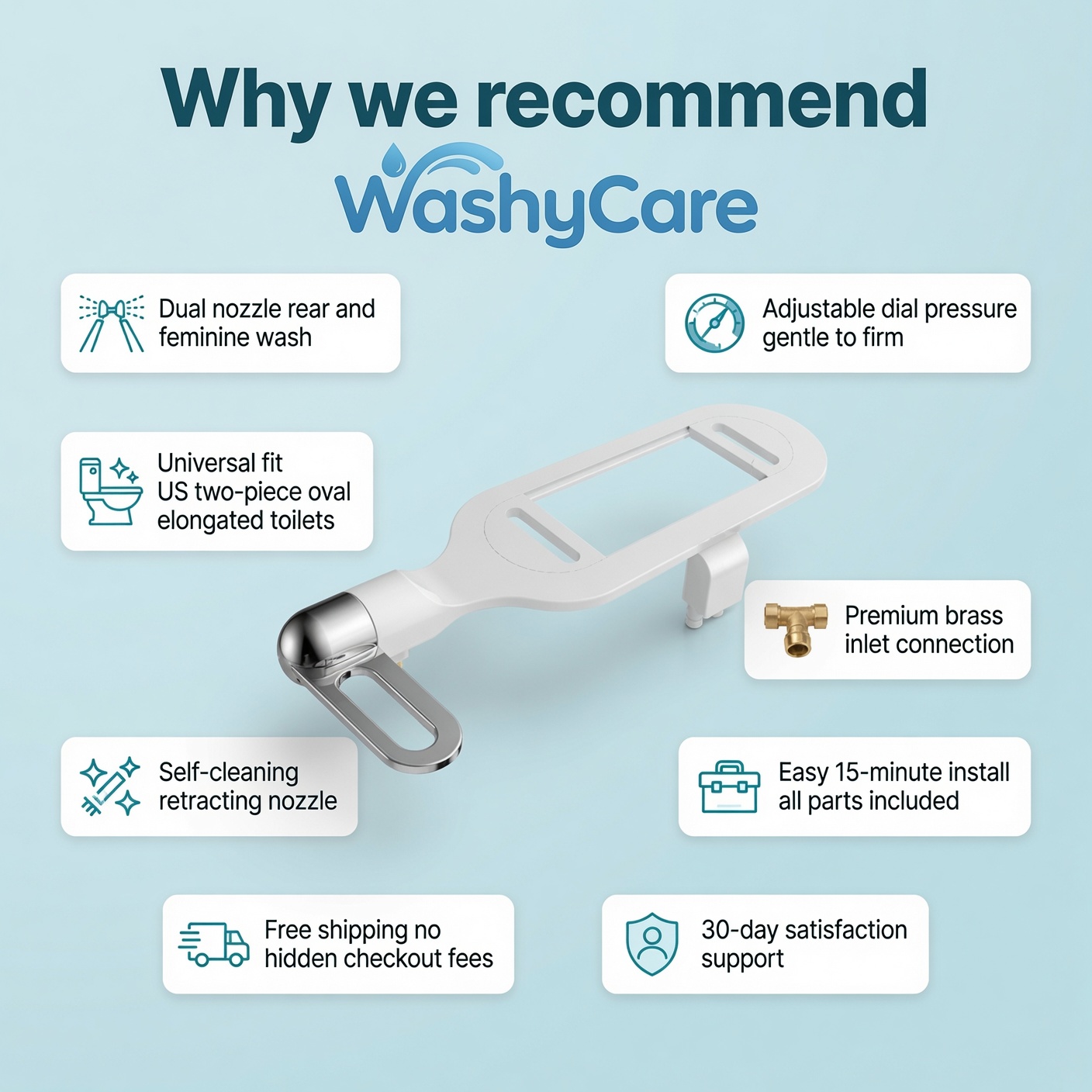
Here's why we recommend WashyCare specifically:
- Dual nozzle design for rear wash and feminine wash, giving you versatile coverage
- Adjustable water pressure with dial control from gentle to firm, without sudden surprises
- Universal fit for the vast majority of standard US two-piece toilets, including oval and elongated seats
- Premium-grade brass inlet at the connection point where cheaper attachments often fail
- Self-cleaning nozzle that retracts and rinses before and after each use
- Easy 15-minute install with every component included and a clear installation guide
- Free shipping with no hidden charges added at checkout
- 30-day satisfaction support if you have any issues with your order
The Offer
While the standard retail price is $115, we are offering a special launch-week discount valid for limited orders only. Keep in mind, this is a single, one-time purchase that covers you for good.
To put that in perspective: the average American household spends approximately $180-$240 per year on toilet paper alone. Most people who switch to a bidet attachment report cutting that spend by 70-80%.
Cost note: Household toilet-paper costs vary sharply by family size, brand, work-from-home habits, and whether paper towels or tissues are counted in the same shopping category. A conservative benchmark is that U.S. consumer units spent about $131 on toilet tissue, paper towels, and napkins in 2024, while consumer surveys have put toilet-paper-only spend around $182 per year. 2024 paper-goods expenditure benchmark · consumer survey benchmark.
Within one year, this thing effectively pays for itself. And then continues paying for itself, every year after that.
| Included with WashyCare | Why it matters |
|---|---|
| WashyCare Bidet Attachment | Dual nozzle, adjustable pressure, and self-cleaning rinse in one slim attachment |
| Complete installation hardware | Everything needed for a standard setup is included in the box |
| Step-by-step installation guide | Designed for a no-plumber 15-minute install |
| Free shipping | Available to all 48 contiguous US states |
| 30-day satisfaction support | Contact support if anything about your order needs to be made right |
$79.95 TODAY $115
Free US shipping, 30-day guarantee, and support from real humans.
Quantities Are Strictly Limited and the Sale May End Early. Final Cutoff: Sunday, 11:59 PM PT.
Claim Your WashyCare Now! Limited Promotional OrdersOne Last Thing
The world didn't collectively decide to use water because of some health campaign or trend.
They just did it. Because it makes logical sense. Because water cleans.
Americans are catching up. Quietly, practically, without much fanfare, millions of households are installing these attachments, using them for a week, and then wondering why they waited so long.
The question you're probably asking right now isn't really "should I try this?"
The question is: "Why hasn't anyone told me about this before?"
The answer is: toilet paper never needed to advertise against anything. It had no competition. Until now.
Questions? Contact support at hiwelly.com. Real humans, real responses. WashyCare is not a medical device; if you have a diagnosed condition, follow your doctor's guidance.