

PREGNANCY & Postpartum Hygiene Report
The One Item Nearly Every US Hospital Sends Home With New Moms - And Why It Was Never Meant to Be the Whole Answer
A plastic squeeze bottle, one sentence of instruction, and no time to explain what it actually means about the months ahead. Here's the rest of the explanation nobody had time to give you.
By The Comfort Standard Community | 8 min read
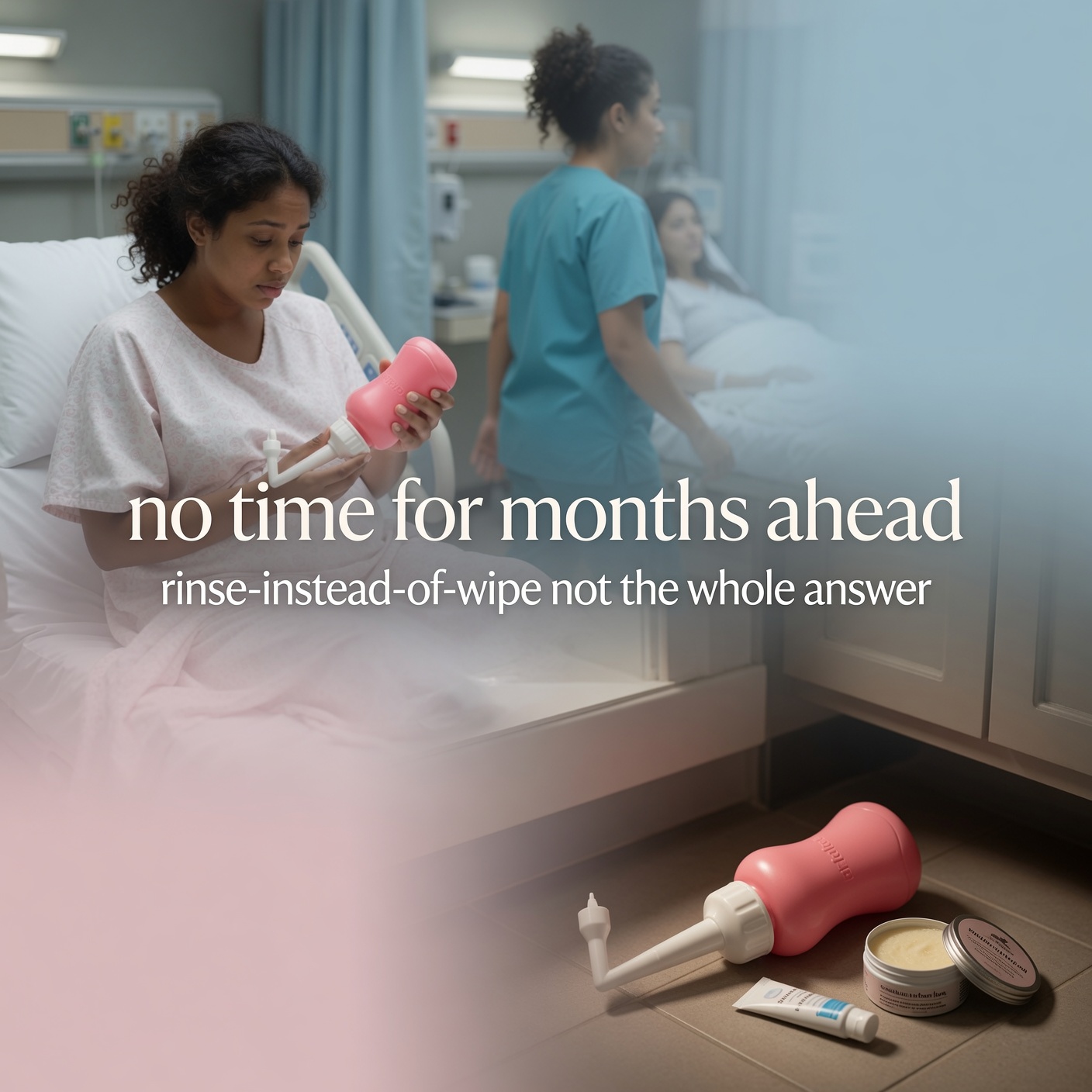
If you've been through a hospital delivery in the United States, you already own the object this article is about. It's small, plastic, and probably still sitting under your bathroom sink right now, half-forgotten, next to the nipple cream and the witch hazel pads.
A nurse handed it to you, said some version of "use this instead of wiping for a while," and moved on to the next task on a very long list. There was no time for more than one sentence. There rarely is.
If you're currently pregnant and haven't met this bottle yet, you will. It's called a peri bottle, and it is close to universal in US postpartum discharge kits. If you're already postpartum, you know exactly the one we mean, possibly on sight of that description alone.
Evidence note: The Bump's hospital-bag guide lists the peri bottle among the common items hospitals send home with new moms. The Bump hospital take-home guide.
Here is what almost nobody says clearly, in more than one rushed sentence, in the middle of the most overwhelming week of your life: that bottle is not a cute freebie. It is quiet, standard medical consensus that for a body that is pregnant, swelling, tearing, or healing, water is the gentle option and dry paper is not.
A hospital handed it to you not as a nicety, but because rinsing instead of wiping is simply the accepted, sensible standard of care for this exact season of a woman's life.
Nobody ever finishes that sentence, though. And the second half matters just as much as the first.
Confirming What You Already Suspected
If you clicked through from an ad about this exact bottle, you're probably here because something about it rang true. Let's back that up with the parts that don't fit in a hospital hallway.
The problem starts long before delivery. Hemorrhoids are one of pregnancy's most common and least-discussed realities. Depending on the study, somewhere between 25% and 35% of pregnant women develop them, and some research places the figure as high as 85% by the third trimester, as pressure from the growing uterus and rising blood volume both increase.
Evidence note: Cleveland Clinic describes pregnancy hemorrhoids as common, and an NIH/PMC review on perianal disease in pregnancy discusses the wide reported prevalence range. Cleveland Clinic · NIH/PMC review.
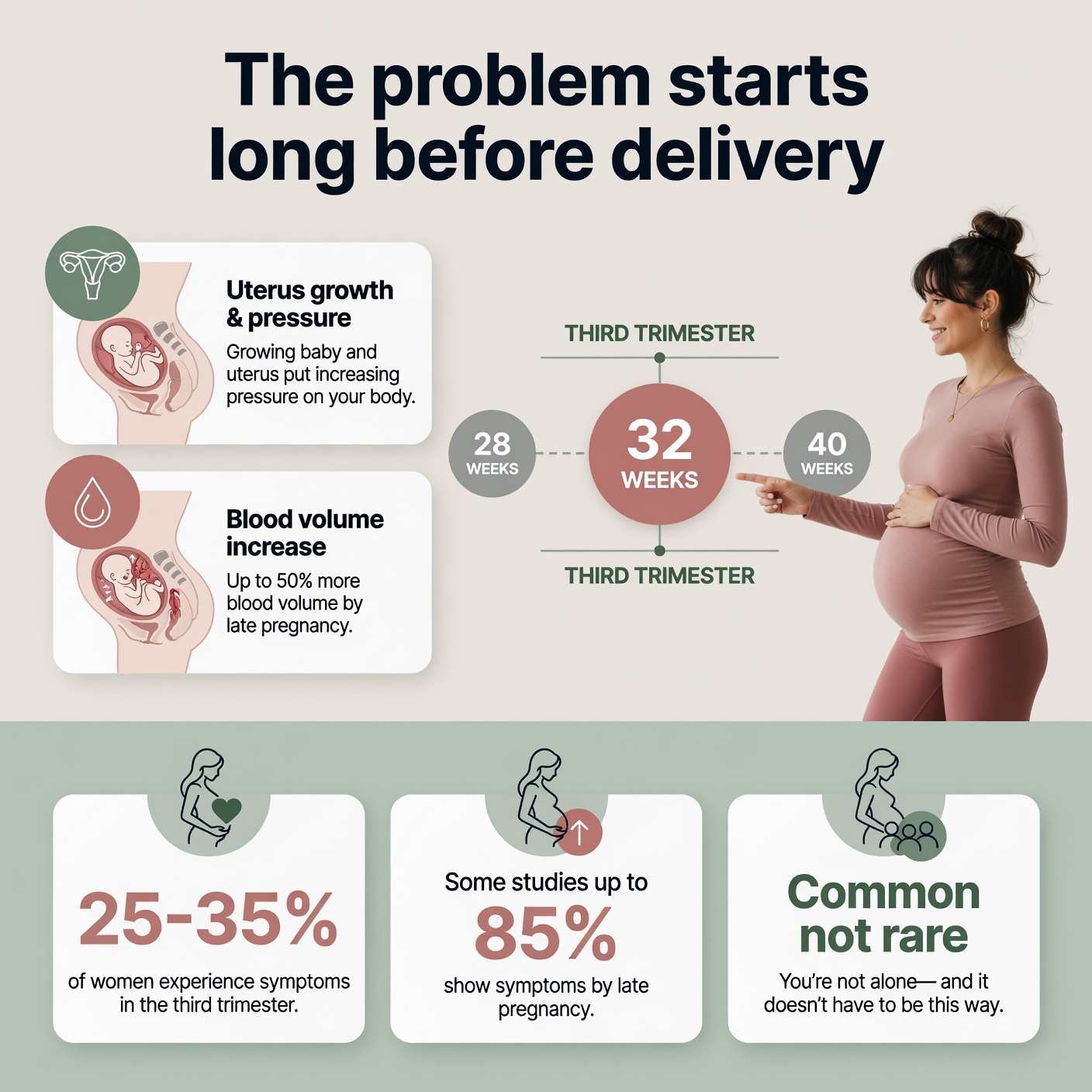
That is not a rare complication whispered about in one corner of a waiting room. Statistically, it is close to a coin flip that it's already true for you, whether or not the word has come up yet in conversation.
The instruction doesn't end at the hospital door. Standard postpartum nursing guidance - the same guidance behind that bottle - tells new mothers to fill it with warm water, rinse instead of wipe, and even spray gently while urinating to dilute the sting on healing tissue. This isn't a home remedy someone's aunt swears by. It's printed on hospital discharge sheets across the country.
Clinical note: ACOG's postpartum pain guidance tells mothers to clean the genitals with warm water from a squeeze bottle while on the toilet and pat dry afterward. Mayo Clinic's vaginal-birth recovery guidance gives the same practical instruction: spray warm water over the perineum as you urinate, and use warm water soaks for soreness when appropriate. ACOG postpartum pain guidance · Mayo Clinic postpartum care.
And the same conclusion shows up from a completely different crowd, for completely different reasons. Outside the pregnancy world entirely, a large anonymous audience has arrived at the identical idea - water over paper - from a totally different angle: general comfort and hygiene, not pregnancy at all.
Two completely different rooms - a hospital discharge desk and an anonymous internet forum - landed on the exact same answer, for different reasons, without knowing about each other. That's not a coincidence. That's just what happens to be true.
Why the Bottle Was Right and the Bottle Was Also Not Enough

Here's the part that can feel a little uncomfortable to say out loud, because the bottle was free, and it was genuinely well-intentioned, and for a lot of women it helped.
But nobody designed it to make this easy. They designed it to be cheap enough to hand out for free, one time, to every patient who walks through the door.
Think about what it actually asks of a body that is exhausted, sore, possibly stitched, and running on almost no sleep:
- Fill it every time, from a specific tap, at a specific temperature.
- Hold it and aim it one-handed, at an angle your body was not exactly built to reach comfortably right now.
- Get through the whole rinse before it runs dry, because there is no dial, no adjustable pressure, and no second setting.
- If it runs out mid-rinse, get up carefully, painfully, however that looks this week, refill it, and start again.
- Do all of this while possibly holding, feeding, or listening for a newborn the entire time.
None of that is a design flaw exactly. It's a hospital freebie doing the one job it was built for: getting you through the first days. It was never built to be the answer for the months that actually need one - the last stretch of pregnancy, when hemorrhoids and reaching are already hard, and the weeks and months of recovery after, when every trip to the bathroom deserves to be the easiest part of your day, not the hardest.
A Note for Late Pregnancy, Specifically

If you are still pregnant, this part is for you.
The reaching problem usually arrives before anyone warns you it's coming. Your belly grows. Bending and twisting behind yourself stops being simple. You're not always sure you got fully clean, and there's a strange, small embarrassment attached to something that feels too minor to mention to your doctor.
Body-mechanics note: This is not imagined weakness. Mayo Clinic notes that, as pregnancy progresses, ordinary activities like sitting and standing can become less comfortable. Ergonomics research on pregnant workers has also documented that pregnancy-related body changes can make reaching and lifting everyday objects harder. Mayo Clinic working during pregnancy · Applied Ergonomics reach study.
Layer hemorrhoids on top of that, and dry paper stops being a neutral tool. It starts to sting. Bathroom visits go from automatic to something you quietly brace for.
Many providers, anticipating exactly this, already recommend a gentle water rinse over wiping during this stage. The advice is sound. The typical delivery method - a squeeze bottle you have to hold, fill, and aim while your body is already working overtime - is the part nobody questions.
The Bathroom Problem Nobody Puts on the Registry
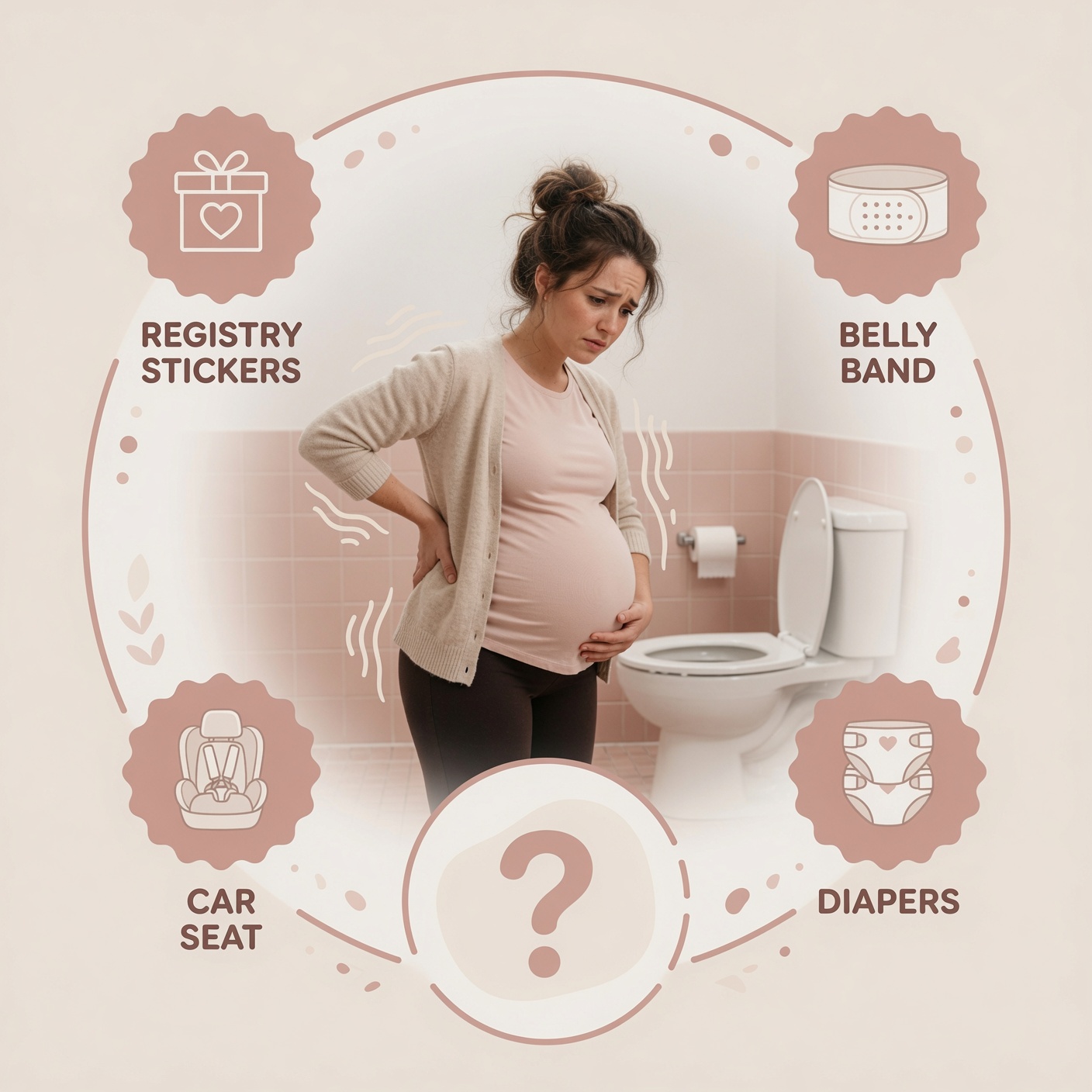
Most pregnancy checklists talk about belly bands, pillows, bottles, diapers, and car seats. Almost none of them talk about the private mechanics of using the bathroom when your center of gravity has changed, your abdomen is heavy, and your body is already doing extra work before the baby even arrives.
Mobility note: Pregnancy-related back and pelvic discomfort is common enough to affect daily function for many women. One review reports rates from 25% to 90%, with most studies estimating about 50% of pregnant women experience low back pain; a later systematic review and meta-analysis estimated global pregnancy back-pain prevalence at nearly 70%. Pregnancy-related low back pain review · Global prevalence meta-analysis.
- A larger belly changes the angle. Bending forward, twisting back, and reaching behind yourself can all become awkward in the third trimester.
- Extra weight makes small tasks feel bigger. Standing up, sitting down, leaning over the sink to refill a bottle, and getting settled again can feel like separate chores.
- Pelvic pressure and hemorrhoids make wiping less neutral. What used to be a quick routine can become a moment you brace for.
- Fatigue changes everything. At 2 a.m., while pregnant or newly postpartum, the best hygiene routine is the one that asks the least from your body.
That is why a fixed, adjustable water rinse matters before birth as much as after birth. It removes the need to aim a bottle, refill it, or twist your body through an angle that no longer feels simple.
A Note for the Postpartum Weeks, Specifically

If you've already delivered, you don't need this explained. You need it validated.
In those first days and weeks, that area needs every ounce of gentleness available. It's healing in a way you've likely never experienced before, whether from tearing, an episiotomy, or a C-section incision that makes even standing up an event. The idea of dragging dry paper across any of that is not just unpleasant - for many women, it's genuinely painful.
This is precisely why the bottle exists, and precisely why it's usually not enough on its own for more than the first week or two. A fixed, adjustable rinse - one you don't have to fill, hold, or refill - simply asks less of a body that is already giving everything it has.
Recovery note: Warm-water care is not a fringe idea in postpartum or anorectal comfort. Cleveland Clinic describes sitz baths as warm-water care used to relieve discomfort in the perineal region, increase blood flow through anal tissues, and reduce pain, itching, and irritation. That does not make a bidet a medical treatment, but it does explain why gentle water is so often part of recovery advice. Cleveland Clinic sitz bath guide.
Meet WashyCare, by Hiwelly
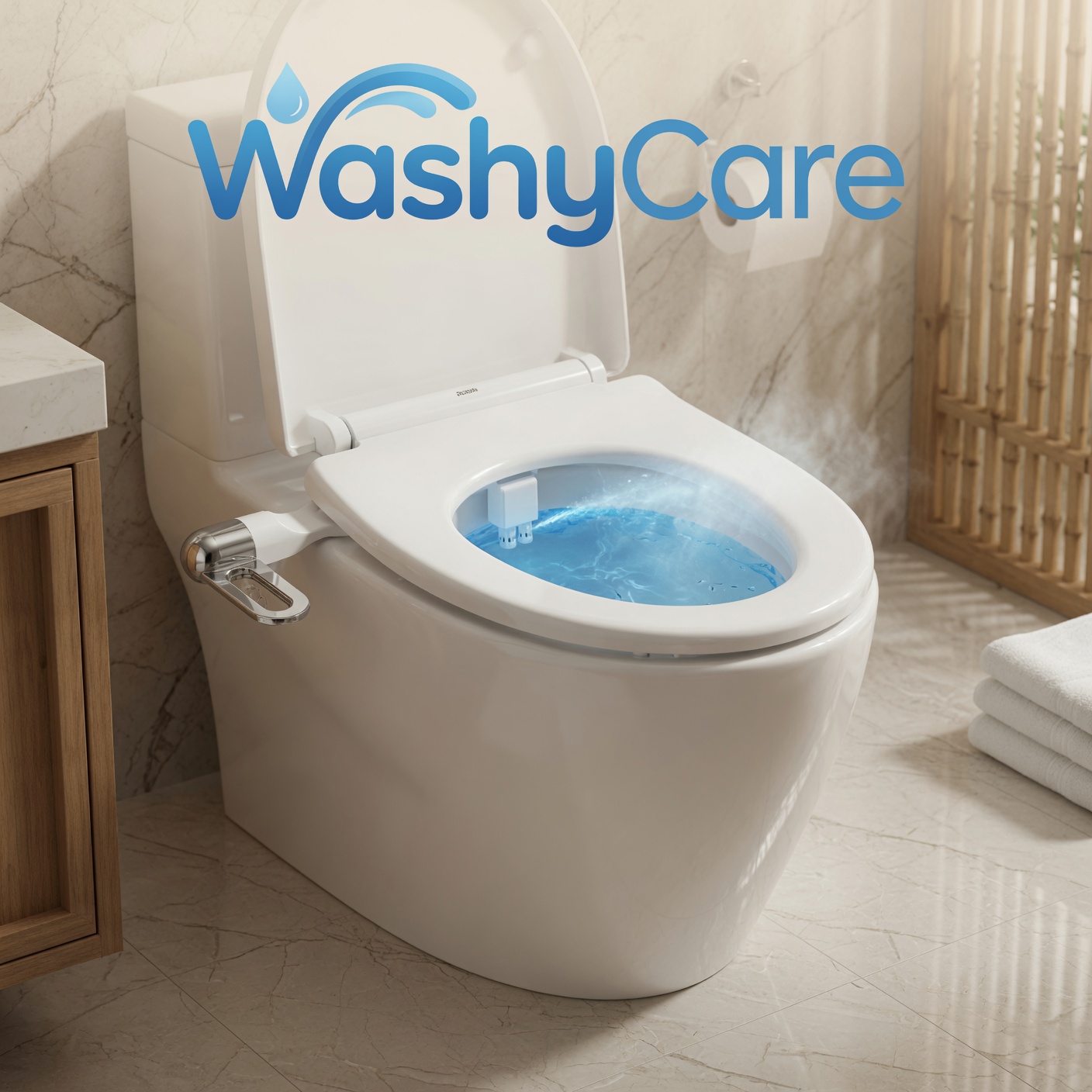
Full disclosure, because we think you've earned straight talk today: this article is published by Hiwelly, and WashyCare is our non-electric bidet attachment. We built it around the exact instruction your hospital already gave you, minus every piece of friction the peri bottle never solved.
- A pressure dial that starts genuinely gentle. You control the entire range yourself, from a whisper-soft rinse upward, only if and when you want more.
- A dedicated feminine-wash setting. A second, softer, separately angled stream for days a general rinse isn't quite what your body needs.
- Nothing to fill, hold, or refill. The water is already there, aimed and ready the moment you sit down.
- Nothing to plug in, nothing to renovate. No electricity, no batteries, no outlet required.
- A first-week guide included with every order. Comfortable starting pressure, a gentle pat-dry routine, and what to expect in the first few uses.
A Practical Note for Partners and New Dads

If you are reading this as a husband, partner, or soon-to-be dad, this is one of the rare baby-prep jobs that is both practical and fast. It is not another item that sits in a drawer waiting for the baby. It is a fixture the whole household can use every day, before delivery, during recovery, and long after the newborn phase is over.
Most of the setup is ordinary household help: turn off the toilet's water valve, remove the seat, place the attachment, reconnect the hose, and turn the water back on. No electrical outlet, no renovation, no permanent change to the bathroom. For renters, that matters. For a pregnant partner who is tired of bending, reaching, and refilling bottles, it matters even more.
- A useful pre-birth install. Put it in before the hospital bag is packed, so the bathroom is ready when late pregnancy and postpartum recovery get harder.
- A whole-family upgrade. Mom may be the urgent reason to buy it, but everyone can use the same cleaner, water-first routine.
- A small way to remove daily friction. The best support is often not another speech. It is making one repeated task easier before she has to ask.
To be direct, because your body deserves honesty more than a sales pitch right now: WashyCare is not a medical device. It does not treat, prevent, or cure hemorrhoids, tearing, or any other condition, and it is not a substitute for guidance from your doctor or midwife. If anything about your pregnancy or recovery concerns you, please talk to them first.
What WashyCare does is simple and real: it takes the rinse-not-wipe standard your hospital already gave you, and removes the parts that made it hard to follow through on.
Let's Answer What You're Already Wondering
Isn't a $9 peri bottle basically doing the same thing, for less?
It's chasing the same idea - water over paper - but not the same experience. The peri bottle asks a sore, tired body to do more work: fill it, hold it, aim it, refill it, repeat. WashyCare asks your body to do almost nothing except sit down. Same principle. Far less effort, at the exact moment you have the least of it to spare.
Is it safe to use a stronger rinse while pregnant or freshly postpartum?
You are always in control of the pressure. Start at the lowest, gentlest setting - a soft rinse, never a forceful spray - and only adjust upward if and when you want to. As with anything during pregnancy or recovery, follow your own provider's guidance for your specific situation.
Do I need a plumber or an electrician?
No. WashyCare is a non-electric bidet attachment. It connects to your existing toilet water supply and installs on most standard toilets in about fifteen minutes with simple hand tools.
Will the water be cold?
It uses the same clean household water supply that feeds your toilet, usually at room temperature rather than an ice-cold shock. Most people start low, adjust gently, and stop thinking about the temperature after the first few uses.
Is the nozzle actually sanitary?
Quality attachments, including WashyCare, keep the nozzle shielded when not in use and designed to stay clean between uses. If you're already trusting dry paper smeared across sensitive skin, a self-contained rinse nozzle is a smaller leap than it might first sound.
Do I still need the peri bottle at all?
Many women keep it as a travel-size backup for the first hospital days or when away from home. At home, WashyCare becomes the everyday version - no filling required.
How to Use It So It Supports Recovery, Not Irritation
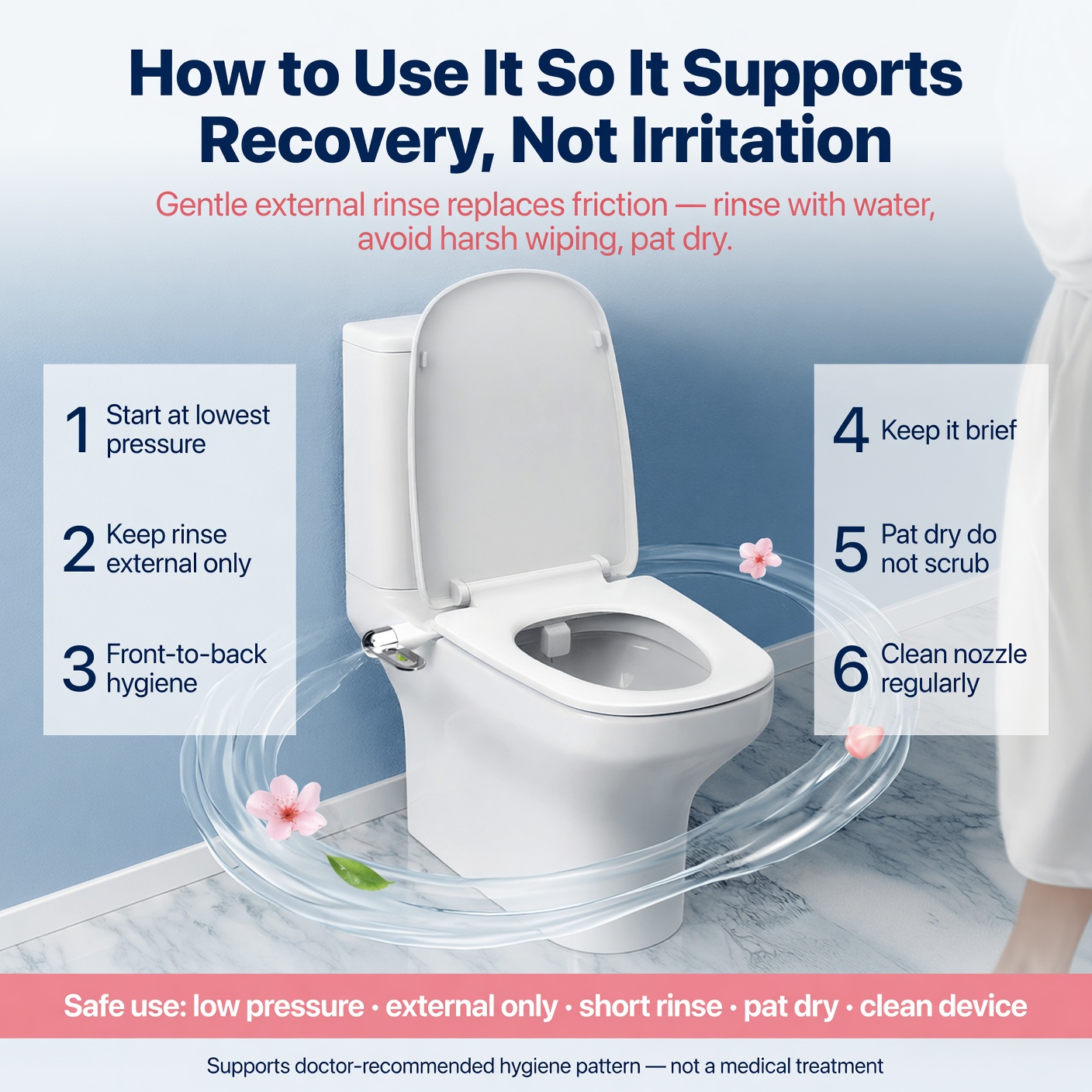
The goal is not maximum pressure. The goal is a gentle, external rinse that replaces friction. Used that way, a bidet attachment can fit naturally beside the same postpartum principles doctors already teach: rinse with water, avoid harsh wiping, and pat dry.
- Start at the lowest pressure. Especially during pregnancy, hemorrhoid flare-ups, or the first postpartum weeks, begin with the softest stream and increase only if it feels comfortable.
- Keep the rinse external. A bidet attachment is for external cleansing, not internal use and not an enema.
- Use a front-to-back hygiene mindset. For vulvar and perineal care, avoid pushing bacteria toward the urethra or vagina.
- Keep it brief. A short rinse is enough. Longer and stronger is not better for sensitive skin.
- Pat dry, do not scrub. Use a small amount of toilet paper or a clean dedicated towel to pat the area dry after rinsing.
- Clean the nozzle regularly. Like any bathroom fixture, it works best when maintained and kept visibly clean.
Safe-use note: Dermatology authors have argued that bidets can be a useful alternative to toilet paper or wet wipes for some perianal skin conditions, but the literature also warns against excessive pressure, excessive duration, burns, fissures, and poor nozzle hygiene. The practical rule is simple: low pressure, external use only, short rinse, pat dry, and clean the device. Dermatologists' case for bidets · Systematic review of bidet use · Nozzle cleanliness study.
That is the honest version of the "helps recovery" claim: not that WashyCare heals tissue by itself, but that it makes the doctor-recommended hygiene pattern easier to follow consistently, while reducing the rubbing and awkward reaching that can make a sensitive recovery feel worse.
Why hundred bucks Is Smaller Than It Looks

While comparable dual-mode bidet attachments with brass fittings typically list around hundred bucks, WashyCare offers a much more budget-friendly alternative with free US shipping and absolutely no hidden fees at checkout.
Now weigh that number the way it actually plays out in your life, not as a single purchase:
- You will use it every day, multiple times a day, through the final months of pregnancy - exactly when reaching and hemorrhoid sensitivity are at their hardest.
- You will use it through the entire postpartum recovery window - exactly when your body needs the most gentleness it has ever needed.
- You will keep using it for years afterward, as a normal, unremarkable part of your bathroom.
Hundred bucks so you stop filling, holding, and refilling a bottle with a sore, exhausted body.
Hundred bucks so the most sensitive, hardest-working season of your body is met with an adjustable rinse instead of a one-shot squeeze bottle.
Hundred bucks against the ongoing cost of extra tissue, wipes, and creams bought to manage a problem the hospital already told you how to solve properly.
Judged as a single object, it's a bathroom fixture. Judged against months of daily comfort during the specific window your body needs it most, the value moves into different territory entirely - not a miracle claim, just comfort and dignity restored during weeks when your body is changing, healing, or both.
You May See Cheaper-Looking Bidet Attachments Elsewhere
That's normal - a bidet attachment can look similar to another in a small product photo. Before comparing only the picture, compare the full order: Is a feminine-wash setting included, or sold separately? Is the pressure genuinely adjustable, or one fixed spray? Does the brand explain plainly what it does and does not claim, or does it lean on vague "medical-grade" language? Is there real support if something about installation confuses you?
If the cheapest anonymous listing is what you want, we may not be the right choice, and that's fine.
If you want a straightforward, honestly-explained upgrade to the exact routine your hospital already recommended, built for the season your body is actually in, this was made for you.
Everything In the Box
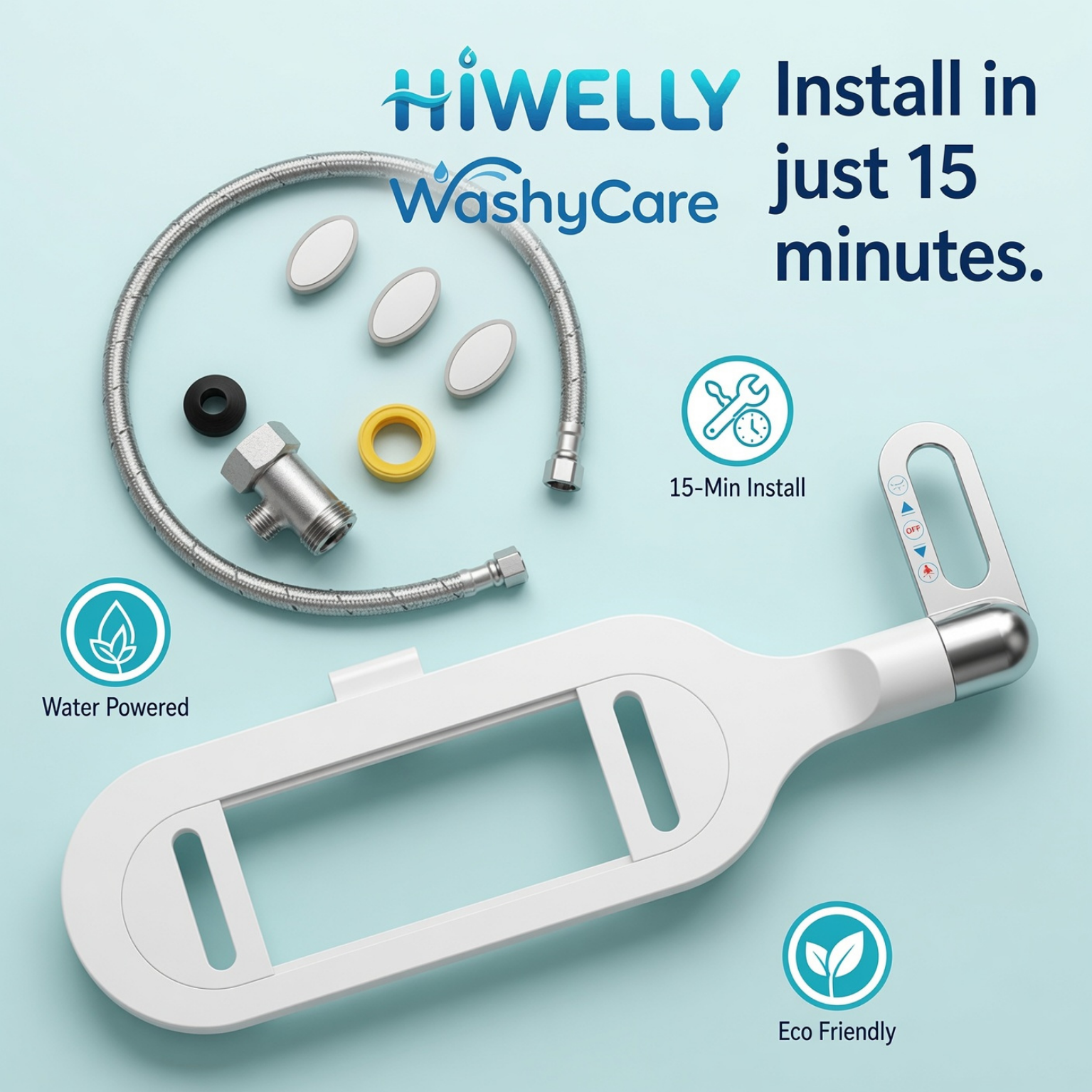
| Included with WashyCare | Why it matters |
|---|---|
| WashyCare non-electric bidet attachment | Gentle-first pressure dial with no filling or refilling |
| Dedicated feminine-wash setting | A softer, separately angled stream for sensitive routines |
| Simple fitting kit for standard toilets | No plumber, no electrician, and no permanent renovation |
| First-Week Guide | Comfortable starting pressure and a gentle pat-dry routine |
| Free US shipping with tracking | No surprise shipping charge at checkout |
| 30-day "No Going Back" guarantee | Try it through the season when comfort matters most |
$79.95 TODAY $115
Free US shipping, 30-day guarantee, and support from real humans.
Quantities Are Strictly Limited and the Sale May End Early. Final Cutoff: Sunday, 11:59 PM PT.
Claim Your WashyCare Now! Limited Promotional OrdersZero-Risk, Because We Know How This Usually Ends
We named our guarantee after the sentence converts keep repeating once they switch from wiping to rinsing: there is no going back.
The 30-day "No Going Back" Guarantee. Install WashyCare. Live with it through the rest of this trimester, or the next two months of recovery - whichever applies to you. If you'd genuinely rather return to dry paper and a squeeze bottle, send the attachment back for a full refund, return shipping covered. No exhausting forms, no restocking fee, no interrogation about why.
We can offer that without hesitation for one simple reason: almost nobody sends back the thing that finally finished what the hospital bottle started.
Who WashyCare Is For

- It's for you if you're pregnant and reaching has quietly become the hardest part of a bathroom visit.
- It's for you if you're managing hemorrhoids and have started dreading a routine that used to be automatic.
- It's for you if you're preparing for postpartum recovery and want to be as gentle as possible with a body that's about to do the hardest work of its life.
- It's for you if you're already postpartum, still refilling that same plastic bottle, and wondering if there's a version that doesn't run out mid-rinse.
- It's for you if you simply believe your body deserves the honest standard of care it was already given at the hospital - finished properly, instead of left as a single rushed sentence on your way out the door.
It may not be necessary if none of this describes you. But if any single line above made you nod, this was built for exactly this season.
The Decision In Front of You

There are two ways to look at this.
The first is to see it as another bathroom accessory and ask whether you really need one more thing right now.
The better way is to see it as finishing an instruction a hospital professional already gave you, in a season where your body has never worked harder or needed more gentleness - and ask how many more months you want to spend filling and refilling a bottle to get there.
Your body is doing something extraordinary right now, whether that's growing a person or recovering from delivering one. It deserves the version of "rinse, don't wipe" that doesn't ask anything more of you than sitting down.
Get WashyCare by Hiwelly today - the non-electric bidet attachment built to finish what your hospital's peri bottle started.
Questions first? A human will answer at support@hiwelly.com.