

Pregnancy & Postpartum Comfort Report
At 34 Weeks, Melissa Had a New Bathroom Routine: Twist, Reach, Wince, Repeat
Then she discovered one small change that made sense for two very different moments—when her belly made wiping awkward, and when her postpartum body would need less rubbing.

The problem is not that your arms suddenly became shorter. Your body changed, but the dry-paper routine still expects the same twisting and reaching.
Meet Melissa T., 34 weeks pregnant
“I’m 34 weeks and every bathroom trip turned into a whole event. Bending down, the hip strain, the fear of losing my balance on the tile—WashyCare completely cut all of that out. One hand, one knob.”
Melissa T. — Third-trimester WashyCare customer
Melissa’s story is personal, but the mechanics are easy to recognize.
As pregnancy advances, the growing uterus shifts your center of gravity. Back discomfort, constipation, hemorrhoids, pelvic pressure, and frequent bathroom trips can all arrive in the same trimester. The task repeats more often just as the movement required to complete it becomes harder.

Why a Two-Minute Bathroom Trip Starts Feeling Like a Workout
The sequence is not mysterious. It is mechanical:
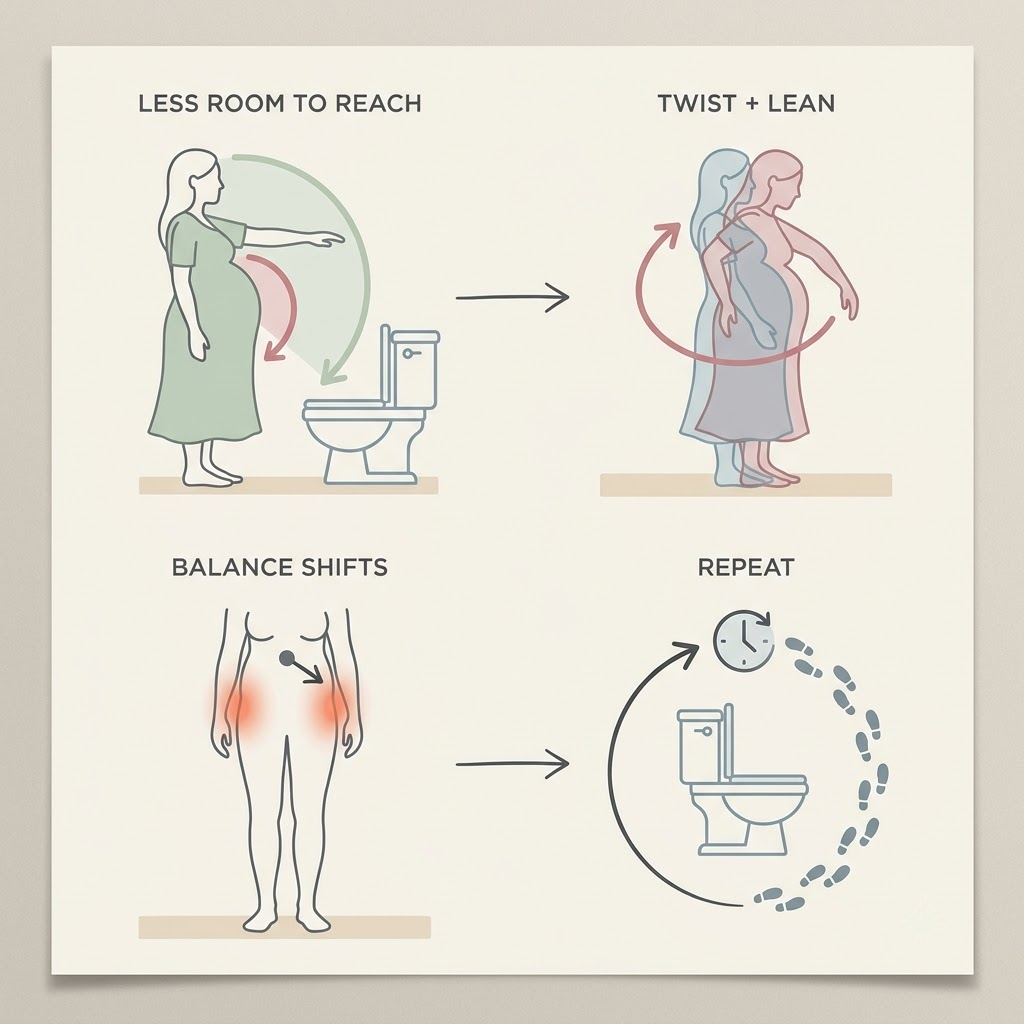
This is the isolated problem: dry-paper cleaning requires your body to reach the area being cleaned.
It is not a failure of flexibility. It is a mismatch between an old routine and a temporarily changed body.
Evidence check: Mayo Clinic notes that third-trimester changes can contribute to back pain, constipation, hemorrhoids, and frequent urination. This supports the movement and repetition problem described here; it does not prove that WashyCare treats any of those conditions. Mayo Clinic: Third trimester
The problem changes after birthFirst It Is Hard to Reach. Then It May Be Too Tender to Rub.
After a vaginal delivery, the bathroom challenge can change overnight.
The perineal area may be swollen, tender, torn, or stitched. Urine may sting. A bowel movement may feel intimidating. The issue is no longer only how far your hand must travel. It is what dry paper does when it arrives.
Before birth: the reach problem
Twist + lean + reach + wipe. Your changing shape must work around the cleaning method.
After birth: the friction problem
Contact + drag + repeat. Tender tissue must tolerate the cleaning method.
This is why hospitals commonly send mothers home with a peri bottle. The instruction is simple: rinse with water, then pat dry instead of wiping.
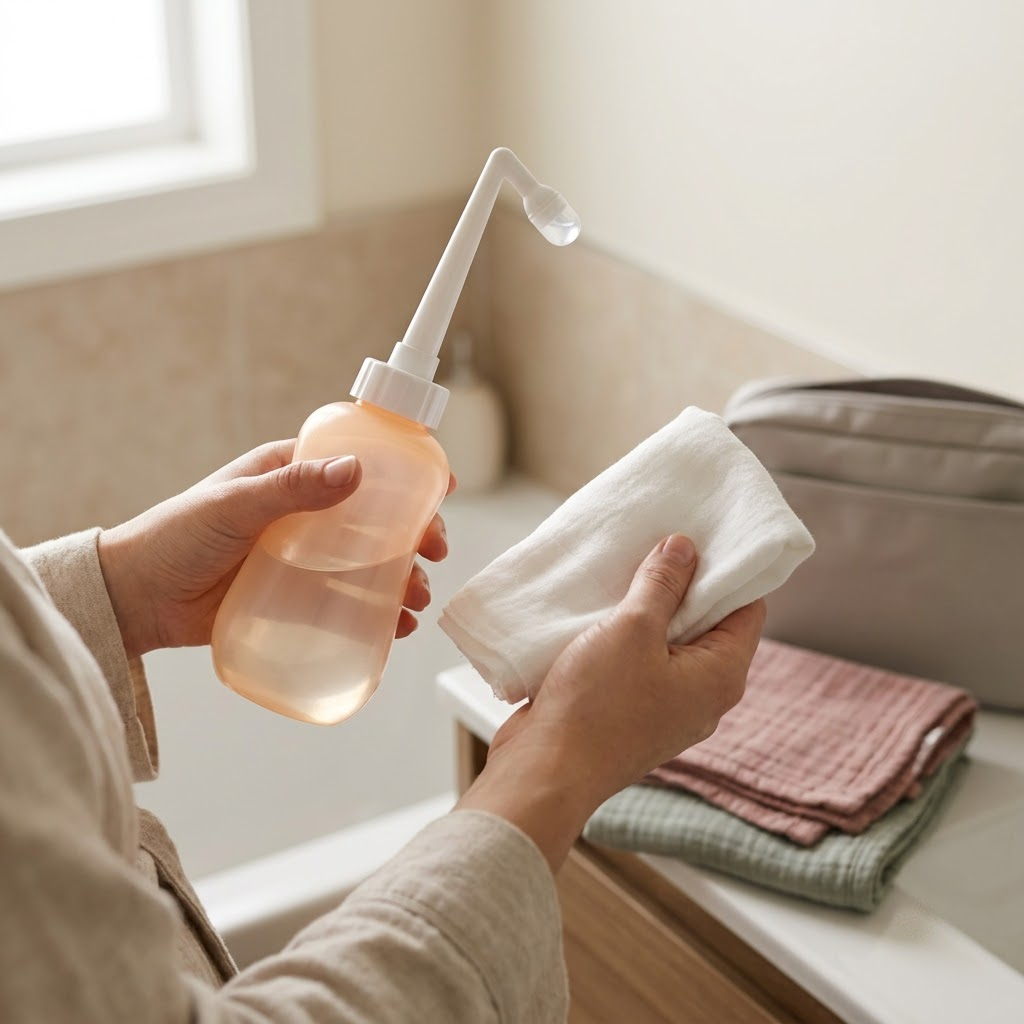
Cleveland Clinic recommends using a peri bottle after bathroom visits and gently patting dry after a vaginal tear. NHS guidance similarly recommends rinsing the vaginal area with warm water and wiping gently from front to back after an episiotomy or perineal tear.
Clinical context: These sources support gentle, water-based external cleansing. They do not endorse WashyCare specifically or establish that any bidet heals a tear. Cleveland Clinic: Vaginal tears · NHS: Episiotomy and perineal tears
Change the Method Before You Ask More From Your Body
If the problem is reach and rub, the clearest solution is not “become better at reaching.”
It is to move the cleaning action to a fixed water source you can control while seated.

The old sequence
Move your body toward the task → reach → make contact → wipe until clean.
The water-first sequence
Remain seated → turn one side knob → rinse externally → gently pat dry.
WashyCare is framed around one practical job across two stages: move the cleaning action away from your hand and into an adjustable side control.
Stage one: use the fixed rinse to reduce awkward reaching in late pregnancy. Stage two: keep the same water-first routine available when direct rubbing may feel uncomfortable after birth.
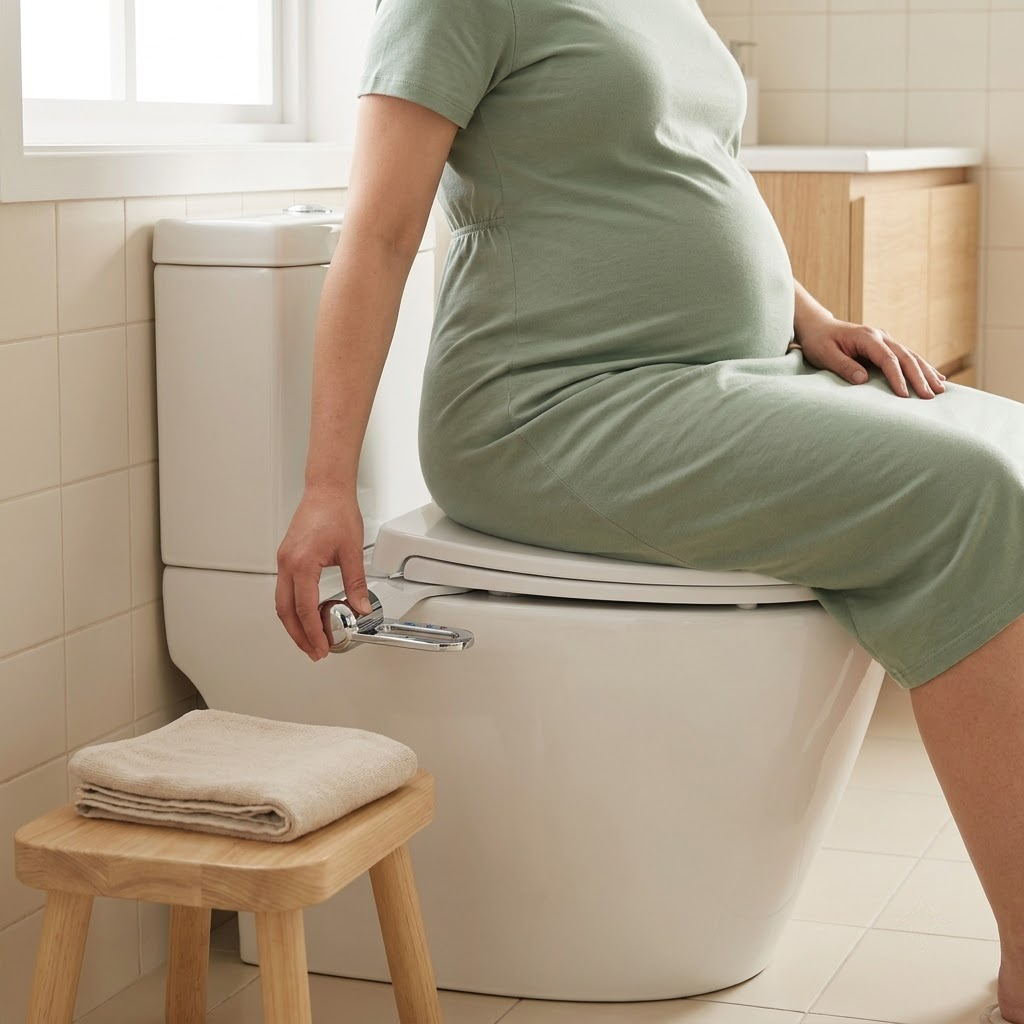
What WashyCare Actually Changes
WashyCare is a slim, non-electric bidet attachment that sits beneath an existing toilet seat and connects to the toilet’s water supply.
Its value is not a long list of disconnected features. Each component removes one step from the old routine:
The side dial replaces reaching
Turn the control beside your hip instead of reaching behind your body with paper.
Adjustable pressure replaces “one force fits all”
Start at the lowest setting and increase only if it feels comfortable.
Rear and feminine wash positions replace guesswork
Select the external rinse position suited to the area you need to clean.
A fixed water connection replaces refilling
No bottle to fill, carry, aim, empty, and refill during an at-home bathroom visit.
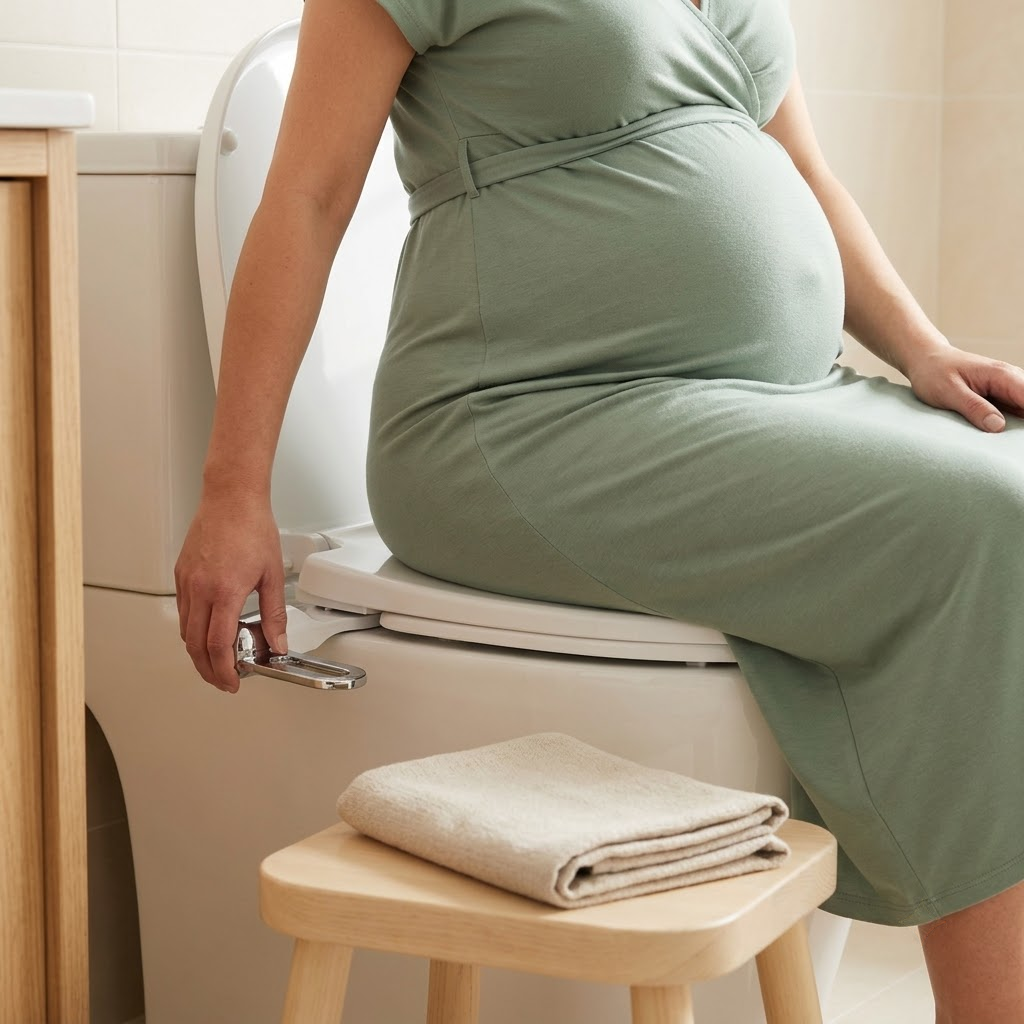
Important: WashyCare is not a medical device and is not a treatment for tears, hemorrhoids, constipation, infection, or pain. It is an external-cleaning tool. Follow your doctor’s or midwife’s instructions, especially after a severe tear, surgery, infection, unusual bleeding, or worsening pain.
Pressure Is a Control, Not a Challenge
There is no prize for turning a bidet to maximum pressure.
A small study of an electronic bidet in 20 healthy adults found different anorectal responses at different pressure and temperature settings. Under high-pressure settings, pressure tended to increase. The study was not conducted in pregnant or postpartum patients, and it was not conducted on WashyCare.
So the honest takeaway is narrow but useful: water settings matter.
- Begin at the lowest pressure.
- Keep the rinse brief and external.
- Use a front-to-back hygiene mindset.
- Pat dry; do not scrub.
- Clean the nozzle regularly.
- Stop if the rinse feels uncomfortable.
- Use the peri bottle instead if warm water or hand-controlled flow is better for your recovery.
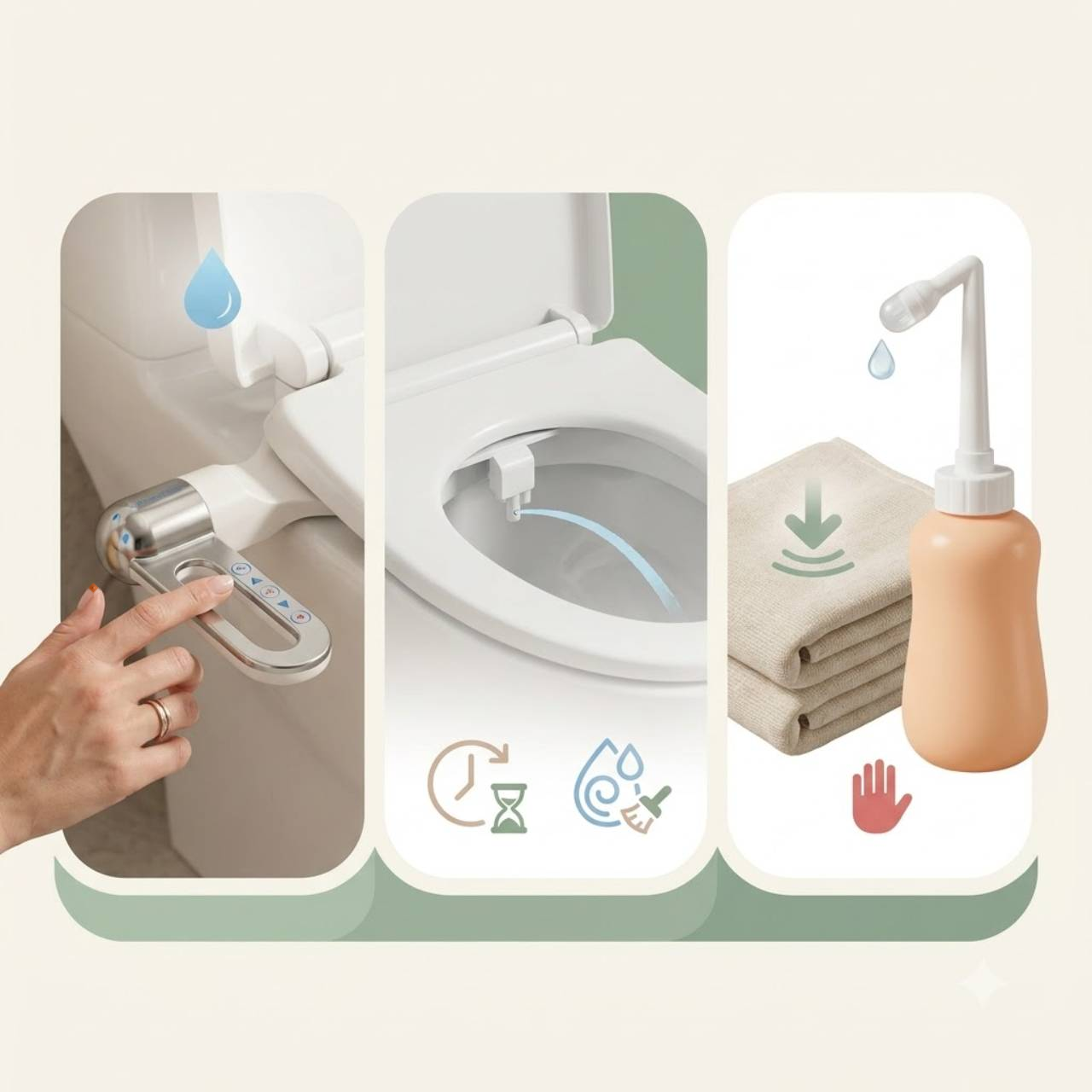
Research boundary: The study used an electronic bidet with defined warm-water settings. WashyCare uses household supply water and has no heater. The research supports the cautious principle “start low,” not a product-specific medical benefit. Journal of Korean Medical Science: pressure study
“I Thought the Hospital Bottle Was the Routine.” Then It Kept Running Out.

“The hospital bottle ran out of water halfway through and made a mess every single time. My stitches made every wipe feel impossible. WashyCare is the postpartum upgrade my body actually needed—gentle, continuous, no friction, no drama. I installed it myself in under 15 minutes.”
Sarah K. — Postpartum WashyCare customer
Sarah’s experience is one customer’s experience, not a promise that every recovery will feel the same. But it answers a precise objection: the water-first method was useful; the repeated fill-and-aim routine was the part she wanted to change.
Seven Reasonable Questions to Ask Before Putting This in Your Bathroom
A product for a sensitive season should not ask you to “just trust it.” Here are the practical limits, tradeoffs, and answers.
1. “Could the pressure be too strong for stitches?”
It could feel too strong if you turn it up. Start at the lowest setting and increase slowly only if comfortable. Some mothers will prefer a peri bottle—especially when warm water or hand-controlled flow is recommended. Ask your provider for recovery-specific guidance.
2. “Could the nozzle be unhygienic or cause infection?”
A retractable nozzle is protected, not sterile. WashyCare’s nozzle remains inside its housing when not in use, but regular cleaning still matters. Keep rinsing external, avoid vaginal or rectal insertion, and stop using it if your provider advises against it.
3. “Will it spray everywhere or leak?”
It is designed for a directed stream and uses a brass valve. Correct installation still matters. Tighten connections according to the manual, restore the water supply slowly, and check every joint for moisture before regular use.
4. “Could I damage my plumbing by installing it?”
The connection is removable and uses the existing toilet supply. The kit includes the attachment, brass T-adapter, braided hose, mounting brackets, and instructions. A suitable standard installation typically takes 10–15 minutes. Stop and use a plumber if a valve is corroded, stuck, or unfamiliar.
5. “What if it does not fit my toilet?”
Do not guess with an unusual toilet. WashyCare is designed for most standard one- and two-piece toilets with a standard bottom-supply connection. Check first if you have a French-curve seat, side-entry connection, or ultra-compact toilet.
6. “What if the water is too cold?”
WashyCare does not heat water. It uses the household supply feeding the toilet, so temperature varies by home and season. If lukewarm water is important to your postpartum plan, keep the peri bottle.
7. “Isn’t the peri bottle already enough?”
For some mothers, yes. A peri bottle is portable, can hold warm water, and offers hand-controlled flow. WashyCare is the fixed, refill-free at-home option. The goal is not to declare one tool universally better; it is to choose the routine that asks less of your body.
About infection concerns: A large observational study reported that normal bidet use in pregnancy posed no clinical health risk for preterm birth or bacterial vaginosis. However, that does not prove safety for every high-risk pregnancy, postpartum wound, device, or cleaning practice. Research on bidet nozzle hygiene also reinforces the need for regular cleaning. Pregnancy bidet-use study · Nozzle-cleanliness study
Dry Paper, Peri Bottle, or WashyCare?
| Decision factor | Dry paper | Peri bottle | WashyCare |
|---|---|---|---|
| Body movement | Requires reaching and wiping | Requires holding and aiming | Side control while seated |
| Direct rubbing | Yes | No; pat dry afterward | No; pat dry afterward |
| Water supply | None | Must be filled and refilled | Continuous household supply |
| Temperature | Not applicable | You choose the water temperature | Unheated household supply |
| Pressure control | Hand pressure while wiping | Hand squeeze | Adjustable side dial |
| Portability | Yes | Yes | No; fixed at home |
| Best role | General use and pat drying | Hospital, travel, warm-water or earliest recovery | Everyday, refill-free at-home rinsing |
A systematic review of habitual bidet use found that current evidence does not establish bidets as a treatment for benign perianal disease. That matters. The defensible promise here is not “healing.” It is a more convenient way to perform an external water rinse with less reaching and no paper-drag during the cleaning step.
Evidence boundary: Systematic review of bidet use in benign perianal disease
What If the Real Risk Is Not the Price?
For a first-time bidet buyer, the hidden risk is usually more personal:
What if I install it, the water feels wrong, my toilet is not a good fit, and I regret adding one more “must-have” item before the baby arrives?
That is the risk the guarantee needs to remove.
The “Make My Routine Easier” Guarantee
Install WashyCare and use it at home. Begin at the lowest setting. See whether the one-knob routine genuinely asks less of your body.
If it does not make your bathroom routine easier, return it within 30 days for a full refund under the current product-page terms.
You are not being asked to predict your future comfort perfectly. You are being given 30 days to find out.
Who This Page Is Really For
WashyCare may fit your routine if…
- You are in late pregnancy and reaching has become awkward.
- You want your home bathroom ready before delivery.
- You want a fixed rinse without filling or aiming a bottle.
- You value very low starting pressure and a side control.
- Your toilet has a compatible standard connection.
It may not be the right tool if…
- Your doctor or midwife advises against a fixed bidet.
- You need warm water for every rinse.
- Your toilet setup is incompatible.
- The lowest setting still feels uncomfortable.
- You mainly need a portable solution away from home.
Prepare One Room for the Person Having the Baby
You will prepare somewhere for the baby to sleep, eat, and change. You can also prepare the room your own body will visit several times a day—on both sides of birth.
$79.95 TODAY $115
Free US shipping, 30-day guarantee, and support from real humans.
Quantities Are Strictly Limited and the Sale May End Early. Final Cutoff: Sunday, 11:59 PM PT.
NOTE: This deal is NOT available on Amazon or eBay.
See the Two-Stage, One-Knob RoutineLess reaching before birth. Less rubbing after.
Not because WashyCare changes what your body is going through. Because it changes what the bathroom asks your body to do.
Sources and boundaries
- Mayo Clinic: Third trimester pregnancy — physical changes, constipation, hemorrhoids, back pain, and frequent urination.
- Cleveland Clinic: Vaginal tears during childbirth — peri-bottle rinsing and pat-dry guidance.
- NHS: Episiotomy and perineal tears — warm-water rinsing and gentle front-to-back cleaning.
- Ryoo et al., 2011 — small electronic-bidet study showing that pressure and temperature settings affect anorectal response; not a WashyCare, pregnancy, or postpartum trial.
- Asakura et al., 2013 — observational pregnancy study on normal bidet use, preterm birth, and vaginal flora.
- Garg et al., 2022 — systematic review finding insufficient evidence to position bidets as treatment for benign perianal disease.
- Product specifications, guarantee terms, and customer quotations are drawn from the supplied Hiwelly WashyCare product-page content. Customer experiences are individual and are not clinical evidence.